
Microduck 3D print and replica guide: STL files, CAD and what is published
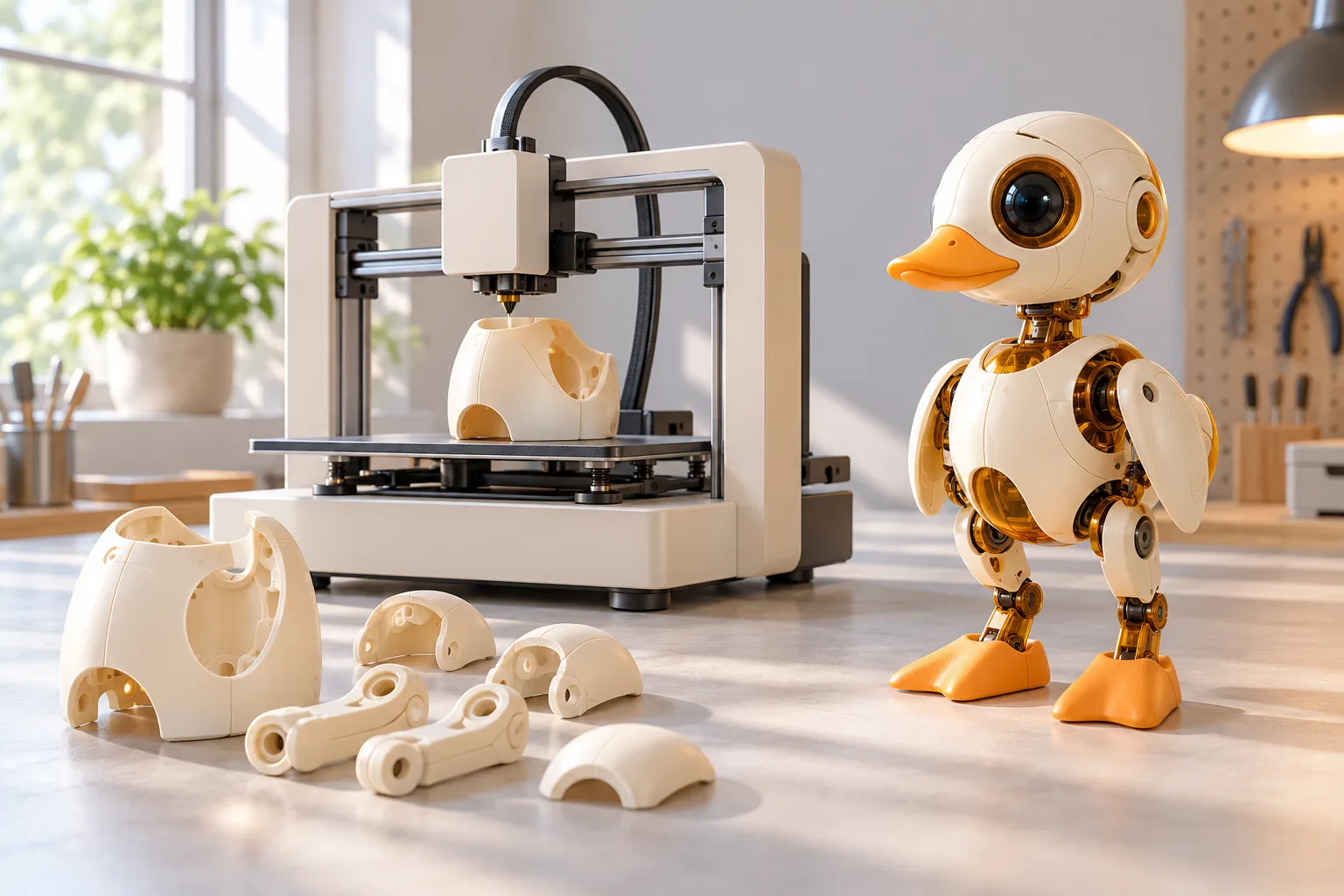
Short answer: Pollen Robotics publishes 43 robot STL meshes and 11 test-bench STL meshes, but not a complete manufacturing package. The meshes are CC BY-NC-SA 4.0 and were made for simulation and visual reference. There is no official production BOM, full electronics design or supported assembly-and-calibration kit. Third-party replicas exist, but they are not official.
This distinction matters because “STL available” is often read as “the whole robot can be printed”. It cannot. The software being open source does not make the mechanical and electronic design files public, and a simulation mesh is not automatically a printable, load-bearing, assembly-ready part.
What is actually published
| Asset | Count | Licence | What it is for |
|---|---|---|---|
| Robot STL meshes | 43 | CC BY-NC-SA 4.0 | Simulation, visual reference, proportions and a starting point for mods |
| XL330 test-bench STL meshes | 11 | CC BY-NC-SA 4.0 | The test rig used around the servo/actuator work |
| MJCF robot descriptions | Published | Apache-2.0 | Simulation models and collision/visual structure |
| Robot software, SDK, simulator | Published | Apache-2.0 | Running and programming the robot |
| RL training code | Published | Apache-2.0 | Training and exporting policies |
| Complete hardware design package | Not published | Not applicable | You cannot treat the repo as a supported manufacturing kit |
The authoritative inventory and licence scope are in the RL repository and its LICENSE-MODELS.md. The file count is from the public asset folders at the time of this page, not a promise that every mesh is a finished printable part.
What “CC BY-NC-SA 4.0” means
The licence allows sharing and adaptation with attribution, but not commercial use, and adaptations must use the same licence. Practically:
- you may print parts for personal experiments;
- you must credit Pollen Robotics and link to the source;
- if you modify and share the mesh, say that you modified it and keep the same licence;
- you may not sell printed copies or a commercial kit made from those files without separate permission.
The software repositories use Apache-2.0, which is a different licence. Do not assume the Apache-2.0 code licence applies to the STL files. The licence file is explicit that the meshes are carved out under CC BY-NC-SA 4.0.
What is missing from the public kit
A complete manufacturing release would need more than visual meshes. The public material does not contain an official production BOM, a supported assembly manual, full mechanical/electronic design files or a calibration process that turns a pile of printed parts into a known-good robot. The absence of those things is the boundary between “replica project” and “product”.
That does not make the files useless. It means the job changes:
| Goal | What the published files give you | What you still have to solve |
|---|---|---|
| Render the robot | Accurate-looking STL meshes and MJCF | Nothing much; respect the licence |
| Design a shell or foot mod | Reference geometry and scale | Strength, clearance, fasteners and balance |
| Build a display replica | External shapes | Internals, electronics, joints and safe power |
| Build a working clone | A research starting point | Motor selection, boards, wiring, firmware, tuning, calibration and support |
| Start using Microduck | Nothing needed from the printer | Buy the finished, calibrated robot |
Can the STL files go straight to a printer?
Treat every mesh as a CAD input, not a print file. Before slicing:
- Check the units and scale against the published dimensions: 25 cm tall and about 800 g for the finished robot.
- Inspect for open surfaces, intersecting shells and zero-thickness features.
- Decide which direction carries load; a cosmetic shell and a hip bracket need different material and orientation.
- Add clearances for fasteners and moving joints instead of expecting a simulation mesh to have printer tolerance.
- Print a small fit test before committing to a large piece.
The robot balances on two legs, so a part that looks right but changes stiffness or mass can change the walking behaviour. The stock hardware is the reference; a printed replacement is an experiment until you have tested it.
Third-party replicas and CAD
A third-party project, fanhao375/microduck-replica, describes itself as a mechanical and electronics reconstruction derived from the official MJCF and Rust source. It is useful evidence that people are reverse-engineering the platform, and it may be a starting point for CAD exploration. It is not an official Pollen Robotics release, and this page does not endorse its fit, safety, electrical design or compatibility with the shipped robot.
If you use a community replica:
- read its licence and provenance before printing or sharing;
- expect measurements to differ from the production robot;
- check every load path and power connection yourself;
- do not present the result as an official Microduck;
- keep the official support channel separate from community build help.
For official-source guidance and avoiding lookalike stores, see Microduck official sources.
Build versus buy, in real numbers
Building a working clone is not the cheap route around $399. Count the parts before you count the fun:
| Build input | Why it is not trivial |
|---|---|
| 15 motors and matching drivers | The wrong torque, voltage or connector changes every policy |
| Camera, LiDAR, two IMUs, ToF | The published policies depend on the sensing stack |
| Main board and power path | Needs the right interfaces, protection and thermal margin |
| Battery, charger and controller | A generic pack is not automatically compatible or safe |
| Printed and machined structure | Strength, tolerances and assembly order all matter |
| Spares and failed prints | A first build consumes both |
| Calibration and policy integration | The expensive part is making the whole system behave predictably |
The $399 pre-order buys a finished, calibrated robot with the seven moves installed, a controller, a battery, a cable and support. The specs page lists what ships. A build project buys learning and control; it does not buy a shortcut past integration.
Safer places to start modding
If you already own a Microduck, start with reversible, low-risk changes:
- feet and foot pads that keep the original geometry and mounting points;
- a shell or decorative panel that does not carry load;
- a stand, ramp or arena for desk play;
- props used by the existing moves;
- new policies trained in simulation before any hardware change.
Avoid replacing a hip, knee or ankle load path just because a printed part fits. Test small, keep the originals, and do not run a new structure near a table edge or above a hard floor until it has survived slow, supervised tests.
3D printing and the warranty question
The site does not publish a separate warranty schedule. Opening or modifying the hardware is done at your own risk, and support will need the order details plus a clear description of what changed. A printed cosmetic foot is a very different support case from a rebuilt leg with a different motor and a modified power rail.
If the goal is simply to own the robot, print nothing and use the finished product. If the goal is the project, read Microduck DIY before buying a spool and the alternatives page before assuming a different small robot is a cheaper platform for the same work.
Microduck 3D print FAQ
Can I 3D print a complete Microduck? Not from an official manufacturing package. The published STL files are simulation and visual meshes, not a supported kit with the complete mechanical design, electronics, BOM and calibration process.
Can the Microduck STL files go straight to a printer? Treat them as a starting point. Inspect scale, wall thickness, clearances and support needs in your slicer. A mesh built for simulation is not automatically a strong or assemblable printed part.
Can I sell printed Microduck parts? The STL meshes are CC BY-NC-SA 4.0, which excludes commercial use. Selling printed copies or adaptations is outside that licence unless you obtain separate permission.
Does printing or modding void support? The site does not publish a separate warranty schedule. Opening or modifying hardware is done at your own risk, and support will need the order details and a clear description of what changed.
Is there an official Microduck CAD download? No complete official CAD manufacturing package is published. Third-party replicas exist and may provide reverse-engineered CAD, but they are not official and their fit, safety and quality are not endorsed.
Where to go next
- Microduck DIY - the build, mod and printing route
- Microduck specs - the hardware the files are meant to represent
- Microduck projects - twelve things to build and try
- Microduck alternatives - other small robots and kits
- Microduck vs Open Duck Mini - two open-robot approaches compared
- Microduck reviews - what coverage and owners say
- Official sources - buy the finished robot safely