
Microduck vs SO-101: legs or arms for embodied AI?
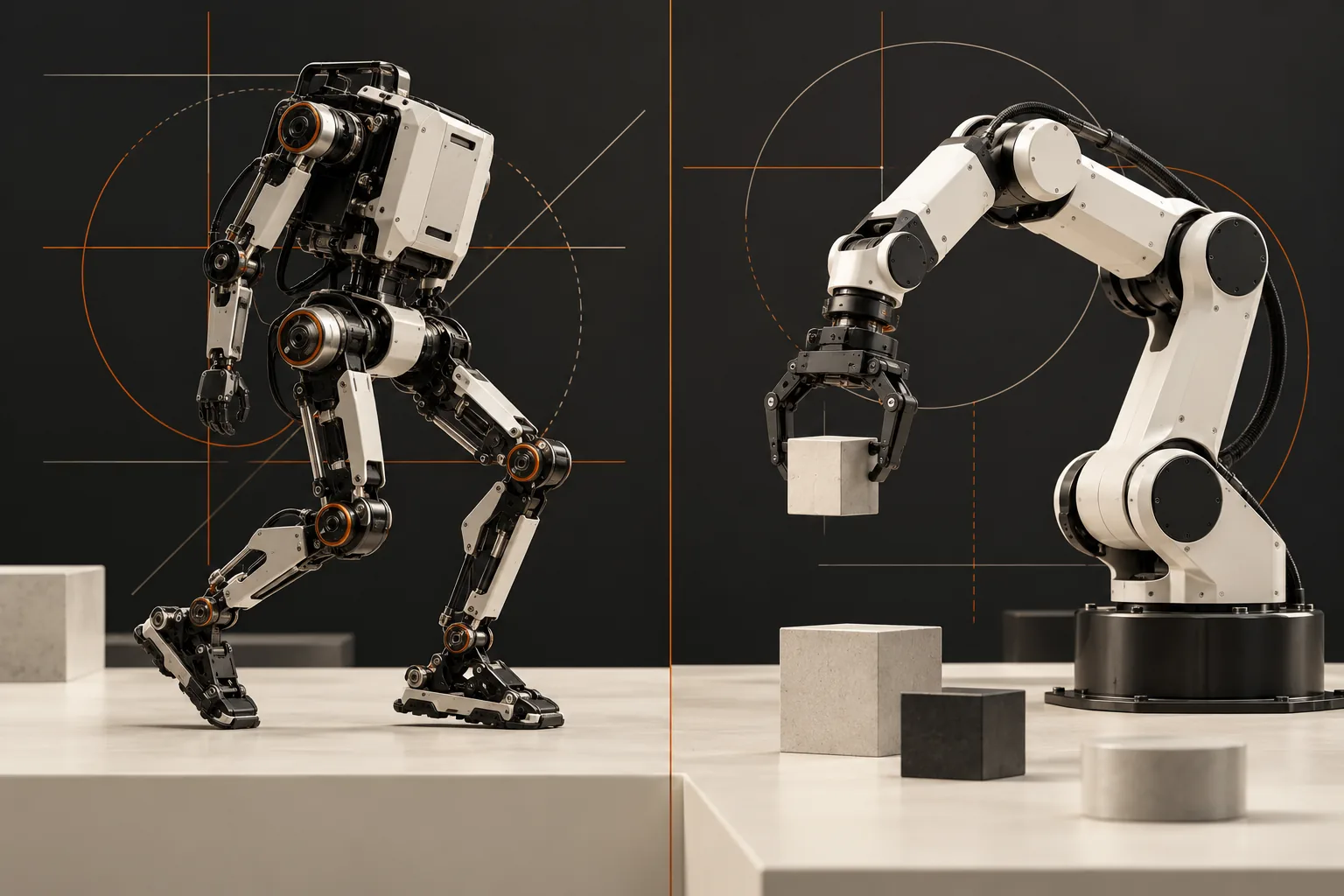
Short answer: Microduck and SO-101 are not substitutes. Buy Microduck to learn locomotion, sim-to-real policy training and the behaviour of a physical biped. Build or buy SO-101 to collect demonstrations, learn imitation learning and work on grasping and manipulation. The current LeRobot BOM lists one follower arm at US$121.94 and a leader-plus-follower pair at US$229.88, before printing, tools and delivery; Microduck is $399 assembled before taxes and shipping.
We make Microduck, so this page starts with the task instead of a biased feature count. Legs and arms teach different parts of embodied AI. Choosing between them is closer to choosing a course than choosing a faster processor.
Should you choose legs or an arm?
Choose legs when the project depends on balance, contact, locomotion or deploying policies on a moving robot. Choose an arm when the project depends on perception, grasping, teleoperation or imitation-learning datasets.
| Goal | Better fit | Why |
|---|---|---|
| Train a walking policy and move it from simulation to hardware | Microduck | Biped, public RL environments and an onboard policy loop |
| Learn demonstration collection and manipulation | SO-101 | Leader/follower teleoperation and LeRobot workflows |
| Learn balance, falling and recovery | Microduck | Legged locomotion is the robot's main job |
| Learn grasping and pick-and-place | SO-101 | A gripper and arm are the direct tools |
| Start without 3D printing | Microduck | Arrives assembled, calibrated and playable |
| Start with a low-parts-cost build project | SO-101 | Open arm design with published part costs |
Many robotics groups should eventually use both. A lab can collect manipulation data with an arm while using a biped to study locomotion and controller deployment.
How do the two systems compare?
Microduck is a finished mobile robot built around walking. SO-101 is an open hardware arm built around data collection and manipulation. Their software ecosystems overlap in the broad language of embodied AI but support different experiments.
| Microduck | LeRobot SO-101 | |
|---|---|---|
| Main task | Walking, balancing, kicking, recovery and policy deployment | Teleoperation, imitation learning, grasping and manipulation |
| Price checked 23 Oct 2026 | $399 assembled, before taxes and shipping | Official US parts example: $121.94 one follower, $229.88 leader and follower, before printing and delivery |
| Hardware | 25 cm biped, about 800 g, 15 motors, camera, LiDAR and two IMUs | Six-axis small arm with gripper; leader arm can be added for teleoperation |
| Arrives as | Assembled robot with battery and controller | Source or print parts, or buy an assembled/kit version from a third party |
| Software path | Python SDK, robot runtime, simulator and mjlab RL environments | LeRobot Python library and robot datasets |
| Core learning mode | Reinforcement learning and sim-to-real locomotion | Teleoperation and imitation learning |
| Open hardware | Complete mechanical and electronic designs are not published | Open arm design and bill of materials |
| Best for | A self-contained biped platform | A flexible, low-cost manipulation lab |
SO-101's price is not a delivered-product quote. The official LeRobot README lists regional supplier prices and excludes 3D printing, delivery, tax and tools. Microduck's price excludes taxes and shipping but includes the assembled robot and its required first-session accessories.
What does SO-101 cost to build?
The current LeRobot SO-101 README lists a US parts total of $121.94 for one follower arm and $229.88 for the leader-plus-follower teleoperation setup. Those examples make the arm an attractive low-cost route into manipulation, provided you account for the rest of the kit.
Budget for a 3D printer or print service unless you buy an already printed kit. Add the power supplies, motor controller boards, cables, clamps, screwdriver, filament and spare hardware specified by the exact revision. An assembled third-party kit can cost more than the parts table while saving days of assembly.
The official SO-ARM100 repository is the source for the BOM and print files. Use its current prices rather than an old screenshot because regional stock and shipping change frequently.
Which is easier to assemble?
Microduck is easier to assemble because assembly is not part of the purchase. The robot arrives calibrated, the controller is in the box and the seven policies are installed.
SO-101 requires sourcing and printing the mechanical parts unless you buy a kit, then configuring motor IDs and assembling the arm. LeRobot publishes detailed setup and assembly instructions, but the builder is still the integrator. That is a feature when the build teaches what you want to learn and friction when it does not.
Choose the amount of assembly that supports the project. Do not spend the first month building an arm if the actual experiment is about locomotion.
Which software stack should you learn?
Choose Microduck's stack when you want to inspect and train policies for legged movement. The workflow starts with simulation, moves through policy export and validation, then runs the ONNX controller on the robot at 50 Hz.
Choose LeRobot when you want a familiar Python path for robot data, teleoperation and imitation learning. SO-101's leader arm lets a person move the follower by demonstration, creating the dataset that trains a manipulation policy.
Neither stack is wasted if you later switch. The shared skills are Python, dataset discipline, sensor calibration, evaluation and the habit of testing in simulation or with safe limits before running a new model on hardware.
Which is better for a research lab?
A research lab should choose by experiment, not brand. Microduck fits work in legged locomotion, control-policy deployment and simulation transfer. SO-101 fits manipulation, teleoperation, demonstration datasets and low-cost replication across multiple stations.
If the lab needs many arms for parallel data collection, SO-101's lower per-arm parts cost is structurally attractive. If the research asks how a learned gait behaves on a physical machine, Microduck provides the complete walking platform without a body-build dependency.
For a survey project or shared course, start with the simulation tools. Microduck's browser simulator and LeRobot datasets can both be explored before hardware arrives.
Microduck vs SO-101 FAQ
Are Microduck and SO-101 competitors? They compete for the same budget and learning time, but solve different problems. Microduck is a walking robot; SO-101 is a manipulation arm.
Which is cheaper? SO-101's official parts example starts at $121.94 for one follower and $229.88 for a leader-plus-follower setup, before printing and delivery. Microduck is $399 assembled before taxes and shipping.
Which is more open? SO-101 publishes its mechanical design and BOM. Microduck publishes its software, SDK, simulator and RL environments under Apache-2.0, but not a complete hardware manufacturing package.
Can Microduck grasp objects? Its duck-shaped robot can grab with its beak as one of the shipped moves, but it is not a six-axis manipulation arm and should not be compared with SO-101 for fine manipulation.
Which should a beginner choose? Choose Microduck for a walking robot that works out of the box. Choose SO-101 when the goal is specifically to build or source an arm and learn LeRobot demonstration workflows.
Key takeaways
- Legs and arms teach different embodied-AI skills.
- Microduck is the assembled locomotion platform at $399.
- SO-101 is the low-cost open manipulation platform, with official US parts examples starting at $121.94.
- SO-101 prices exclude printing, tools, shipping and tax.
- Many labs will benefit from both rather than forcing one machine to do both jobs.
Where to go next
- SO-101 documentation - assembly and setup
- SO-ARM100 BOM - current parts and print files
- Best biped robots - the walking category
- Microduck training compute - hardware for policy training
- Pre-order Microduck - the assembled locomotion path