
Microduck vs TonyPi: which biped should you buy?
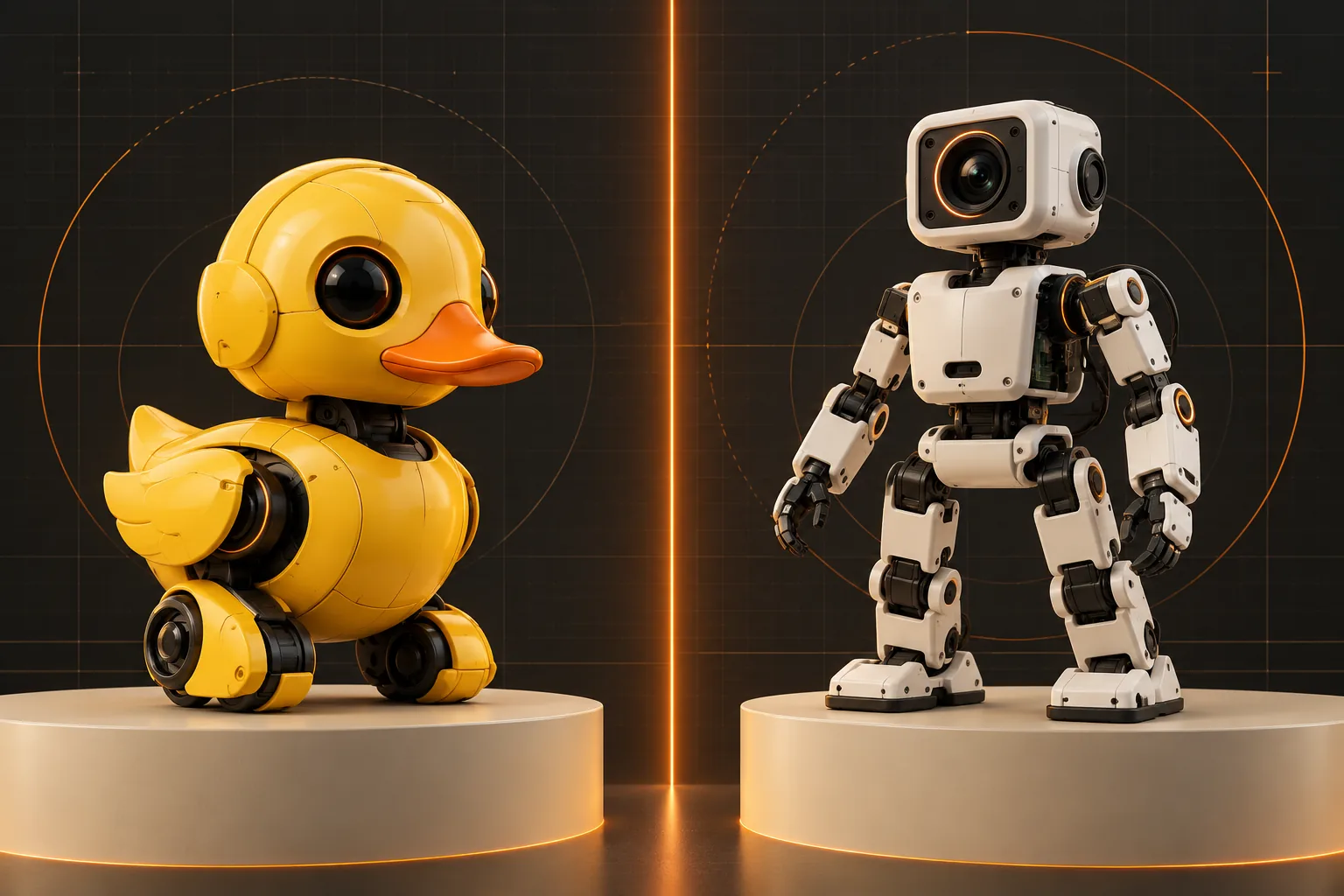
Short answer: Buy Microduck when you want a $399 desktop biped with open Python software and reinforcement-learning policies you can retrain. Buy Hiwonder TonyPi when you want a conventional humanoid kit with Raspberry Pi, AI vision and voice examples, and you value Hiwonder's ready-made platform over an open locomotion-training stack. TonyPi's current US-store range was $599.99 to $869.99 on 23 October 2026; Microduck was $399 before taxes and shipping.
We make Microduck, so this comparison separates the jobs before naming a winner. Neither robot is a direct copy of the other. One is a compact walking duck built around retrainable locomotion; the other is a larger humanoid product with interaction and vision features.
Which robot should you choose?
Choose Microduck for a smaller robot, a lower current purchase price and an open path from the Python SDK to simulation, policy training and deployment. Choose TonyPi for a humanoid form, Raspberry Pi integration and a feature set built around Hiwonder's examples and product support.
| If your priority is | Choose |
|---|---|
| Retraining walking policies and understanding sim-to-real | Microduck |
| A humanoid body and Raspberry Pi-based AI demos | TonyPi |
| The lowest current all-in robot price | Microduck, at $399 before taxes and shipping |
| Voice, vision and human-like gesture demos | TonyPi |
| Apache-2.0 robot software, SDK, simulator and RL environments | Microduck |
| A closed-platform product with Python programming access | TonyPi |
The right answer becomes obvious once you stop asking which robot is generally better and start asking which learning experience you want.
How do Microduck and TonyPi compare?
Microduck is the smaller, cheaper and more software-open route. TonyPi is the more traditional humanoid experience, with a higher current price and a platform that is not presented as fully open robot hardware and training software.
| Microduck | Hiwonder TonyPi | |
|---|---|---|
| Price checked 23 Oct 2026 | $399 before taxes and shipping | $599.99–$869.99 in the US store, by kit and Raspberry Pi option |
| Form | 25 cm biped duck, about 800 g | Ready-made humanoid robot around a Raspberry Pi |
| Arrives as | Assembled and calibrated, ready to drive | Kit or configured product, depending on the selected bundle |
| Main sensing | Camera, LiDAR and two IMUs | Raspberry Pi vision and interaction stack; verify details for the selected kit |
| Motion | Seven trained moves, every policy retrainable | Humanoid walking and gesture behaviours supplied by Hiwonder |
| Software | Python SDK, Apache-2.0 runtime, simulator and mjlab RL stack | App and Python programming around Hiwonder's platform |
| Training | Public policy-training path from simulation to robot | Not presented by the maker as an open reinforcement-learning stack |
| Hardware openness | Complete mechanical and electronic designs are not published | Closed product hardware |
| Support | Maker support, spare-part packs and community | Hiwonder product support |
| Best for | Desktop locomotion and policy experimentation | Humanoid demos, Raspberry Pi projects and AI vision/voice examples |
TonyPi's options and capabilities change by bundle. Check the exact standard or advanced kit, Raspberry Pi model and included modules before comparing a particular configuration.
Why does TonyPi cost more?
TonyPi starts higher because it is a larger humanoid product with Raspberry Pi computing and Hiwonder's vision, voice and interaction features. The current listing spans standard and advanced kits from $599.99 to $869.99, so a single headline price hides meaningful hardware differences.
Microduck targets a narrower job at $399. It includes 15 motors, a camera, LiDAR, two IMUs, a battery, a controller and seven trained locomotion behaviours. Its lower price is not a claim that it is better at every task; it reflects a smaller machine and a different product scope.
Always compare the exact bundles plus tax, shipping and any required accessories. A cheaper base kit is not useful if it leaves out the module that motivated the purchase.
Which robot is more open?
Microduck is more open at the software and policy layer. The robot runtime, Python SDK, simulator and reinforcement-learning environments are public under Apache-2.0, and the policy contract is documented far enough down to inspect the ONNX observation and action shapes.
That openness has a boundary: complete Microduck mechanical and electronic manufacturing files are not published. TonyPi is the more closed hardware platform overall. Its value comes from an integrated product, Hiwonder's examples and the ability to program it without assembling a platform from research code.
Openness only matters if you plan to use it. If Python scripts and bundled demos satisfy the project, TonyPi's platform may be the more direct experience. If you want to train and replace a walking policy, Microduck's public stack is the more useful kind of access.
Can TonyPi train reinforcement-learning policies?
The Hiwonder product listing presents TonyPi around Raspberry Pi computing, AI vision, voice interaction and Python programming. It does not present a public policy-training stack equivalent to Microduck's mjlab environments and documented ONNX deployment workflow.
Do not assume that programmable means retrainable. A robot can expose Python APIs for commands and demos while leaving its balance and walking behaviours closed. Verify the exact software repository and model-training route before buying either robot for an RL project.
Microduck's training path is unusually explicit: the simulation environments are public, the exported ONNX policy runs inside the 50 Hz control loop, and the observation and action contract is documented. That is the experience to choose when policy ownership is the goal.
Which is better for beginners?
TonyPi is easier to justify for a beginner who wants a humanoid product with guided examples and is comfortable following Hiwonder's platform. Microduck is easier to justify for a beginner focused on a compact walking robot, provided that robotctl, Python and simulation are the topics they want to learn.
Neither machine removes physics. A biped can fall, a floor can be wrong, and a new policy can behave differently in simulation and reality. Microduck's advantage is a shorter route from the shipped behaviours to a simulation and SDK; TonyPi's advantage is a larger integrated humanoid demo platform.
If the user is a child, compare the products' age guidance, supervision requirements and classroom plans directly. Do not infer child suitability from robot size alone.
Microduck vs TonyPi FAQ
Is TonyPi more capable than Microduck? TonyPi covers more humanoid interaction and Raspberry Pi examples, while Microduck is more open for policy training and smaller in form. Capability depends on whether the project needs vision and voice or retrainable locomotion.
Which is cheaper? Microduck is $399 before taxes and shipping. TonyPi starts at $599.99 on the US store checked on 23 October 2026 and reaches $869.99 for the highest listed advanced Pi 5 configuration.
Can both be programmed with Python? Both are offered with Python programming paths, but Microduck publishes its robot runtime, simulator and training environments as Apache-2.0 software. TonyPi remains a Hiwonder product platform.
Can both walk? Both are bipedal products. Microduck ships seven trained moves designed for a small duck-shaped robot; TonyPi supplies humanoid walking and gesture behaviours through its platform.
Which should a school buy? Compare the exact lesson plan, supervision ratio, software account requirements, spare parts and support contract. Microduck publishes a classroom outline and open simulator; TonyPi offers a conventional humanoid platform. The procurement decision depends on the curriculum.
Key takeaways
- Microduck is the lower-priced, smaller and more policy-open choice.
- TonyPi is the more conventional Raspberry Pi humanoid with vision and voice features.
- TonyPi's current official range starts at $599.99, not the old $480 estimate.
- Microduck is best for retrainable locomotion; TonyPi is best for Hiwonder's humanoid platform.
- Compare exact bundles, software access and support before ordering.
Where to go next
- Hiwonder TonyPi - current configurations and price
- Best biped robots - Microduck, Open Duck Mini and TonyPi together
- Microduck alternatives - the wider robot field
- Microduck specs - the full hardware and box contents
- Pre-order Microduck - $399 before taxes and shipping