
Best biped robots to buy or build (2026)
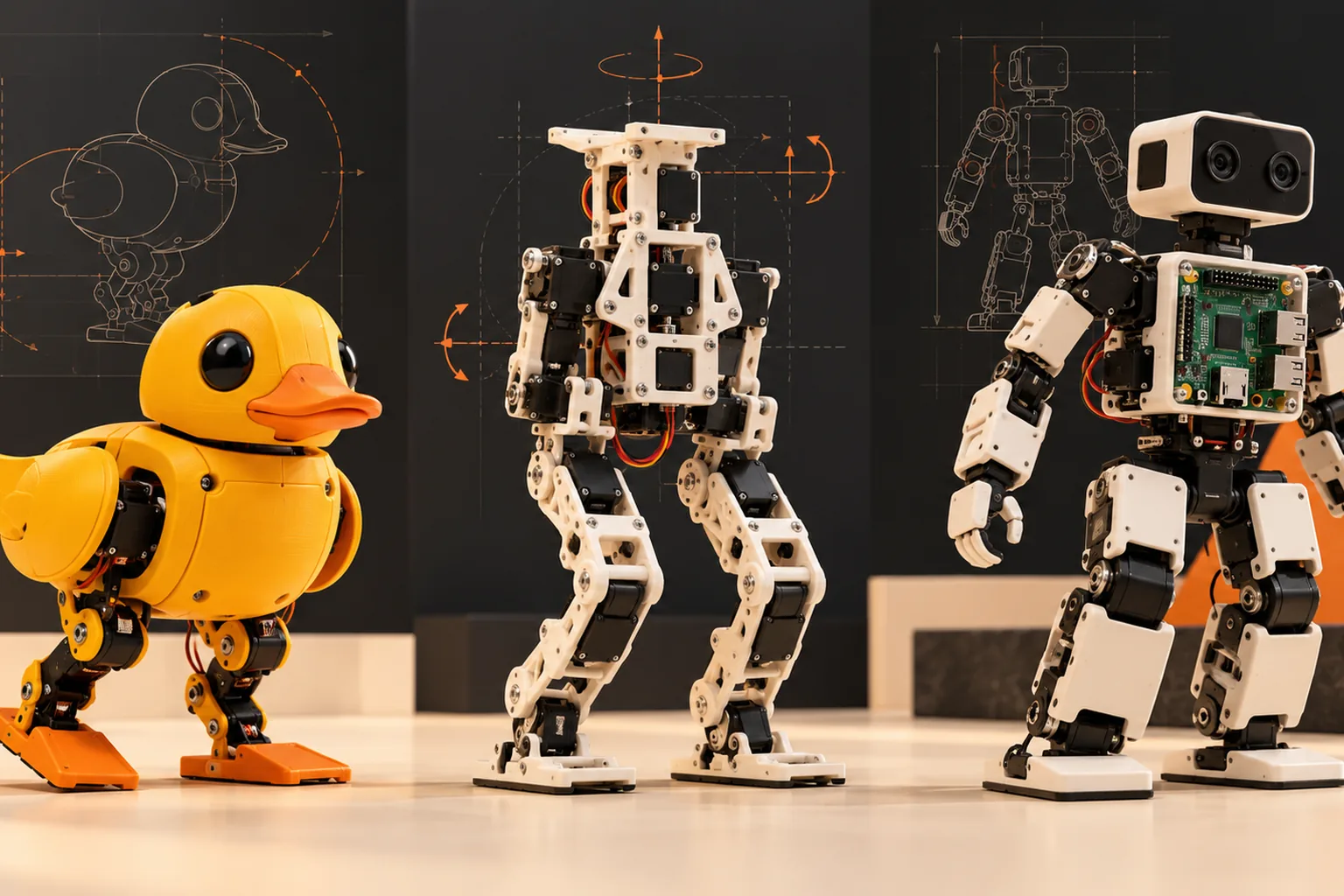
Short answer: Microduck is the best small biped to buy when you want to walk it quickly, program it in Python and retrain its policies for $399 before taxes and shipping. Open Duck Mini v2 is the better choice when 3D printing, sourcing parts and assembling the robot are part of the value. Hiwonder TonyPi is the more appliance-like ready-made option, with a current US store range of $599.99 to $869.99 depending on kit and Raspberry Pi configuration. Prices were checked on 23 October 2026.
This is a commercial category page from Microduck. We make one of the robots compared here, so the recommendation below separates job, budget and ownership experience instead of pretending one machine wins every spec table. Reachy Mini is a compelling desktop robot, but it is not a walking biped and therefore is not included in the walking comparison.
Which biped robot is best in 2026?
The best biped robot in 2026 depends on whether you want a finished product, a build project or a programmable humanoid. Most buyers should start with the buy-or-build question before comparing motor counts.
| Buyer | Best fit | Why |
|---|---|---|
| Want to walk and retrain a robot this month | Microduck | Assembled, calibrated, seven trained moves, Python SDK and public RL stack |
| Want the full mechanical build | Open Duck Mini v2 | Published CAD, BOM, runtime and training work, with a target BOM below $400 |
| Want a ready-made humanoid with Raspberry Pi and vision demos | Hiwonder TonyPi | App and Python workflows, AI vision and voice features, but a closed product platform |
| Want an expressive desk robot that does not walk | Reachy Mini | Interaction and apps instead of legged locomotion |
The table uses published prices and excludes tax and shipping unless stated. It also avoids treating a bill of materials as if it included labour, failed prints and spare parts.
How do the three small bipeds compare?
Microduck is the simplest route to a retrainable biped because the hardware arrives ready and the software is open. Open Duck Mini v2 is the most open route because the body is also part of the project. TonyPi is the most conventional humanoid product of the three.
| Microduck | Open Duck Mini v2 | Hiwonder TonyPi | |
|---|---|---|---|
| Price checked 23 Oct 2026 | $399 before tax and shipping | Official target: full BOM under $400 | $599.99–$869.99 on the US store, by kit and Raspberry Pi option |
| Arrives as | Assembled, calibrated robot | CAD, BOM, files and build guidance | Ready-made kit or assembled product, depending on configuration |
| Size | 25 cm tall, about 800 g | About 42 cm with legs extended | Check the current Hiwonder listing for dimensions |
| Mechanical design | Product hardware; complete design files are not published | Open design files and 3D-printable parts | Closed product hardware |
| Software | Apache-2.0 robot stack, Python SDK, simulator, RL environments | Open runtime and community training work | App and Python programming access; not presented as a fully open robot stack |
| Training story | Seven shipped policies, every one retrainable | Build and train with the community project | Use the behaviours and programming path supplied by Hiwonder |
| Support model | Maker support, support inbox and spare-part packs | Community support; the builder owns integration | Hiwonder product support |
| Best for | Learning sim-to-real locomotion without building the body | Makers who want to own every subsystem | Buyers seeking a conventional, feature-rich humanoid kit |
The size difference matters physically as well as visually. A 25 cm duck is a desk robot. Open Duck Mini v2 at roughly 42 cm is a larger project that needs more room, more material and more handling. TonyPi is a humanoid kit whose value is tied closely to Hiwonder's software and vision examples.
Is Microduck really open source?
Microduck's software is open source under Apache-2.0, but the complete mechanical and electronic designs are not. That distinction is central to the buying decision.
The public repositories include the onboard runtime, Python SDK, simulator and reinforcement-learning environments. You can inspect how the robot moves, change commands, train a new policy and publish a policy to Hugging Face. You cannot download a complete manufacturing package and build an identical robot from the repository alone.
Open Duck Mini v2 makes the opposite trade. Its CAD, bill of materials, printed parts and runtime are part of the project. You get more design freedom and much more integration work.
Is Open Duck Mini v2 cheaper than Microduck?
Open Duck Mini v2 can be cheaper on the parts list, but a builder should not assume it is cheaper as a completed project. Its official v2 README says the full BOM cost should be under $400. The BOM still sits beside printer time, filament, tools, failed prints, fasteners, shipping, tax and replacement parts.
Microduck's $399 buys an assembled machine with one battery, a USB-C cable, a controller and seven installed moves. The comparison changes depending on what you already own. A well-equipped maker may spend less cash and more time. A first-time builder usually spends more than the spreadsheet first suggests.
The dedicated Open Duck Mini v2 build-cost guide breaks down which costs belong in the comparison.
What does TonyPi offer that Microduck does not?
TonyPi offers a more conventional humanoid form, Raspberry Pi-based computing and Hiwonder's AI vision and voice examples. It is a sensible pick when those demonstrations and the established product workflow are the reason you are buying.
Microduck does not compete on humanoid gestures, a human face or a voice-assistant demo. Its narrower promise is a small walking duck with enough sensing and control exposed to study locomotion, collect data and retrain policies. Choose TonyPi for the humanoid platform experience. Choose Microduck for a self-contained path from simulation to a retrainable walking robot.
The full Microduck vs TonyPi comparison covers price, software and ownership in more detail.
Do you need a GPU to use these robots?
You do not need a GPU to drive Microduck or TonyPi. You also do not need a GPU to open Microduck's browser simulator.
Training a new Microduck policy is the compute-heavy task. The practical local path is Linux x86_64 with Python 3.12 and a CUDA-capable NVIDIA GPU; 8 GB of memory or more is the recommended starting point. Hugging Face Jobs is the documented alternative when you do not own that hardware.
The Microduck training compute guide explains which tasks need a GPU and which only need a browser or CPU.
How should a beginner choose?
A beginner should choose the shortest safe route to the experience they want. If the goal is to see a robot walk, retrain something and understand the policy workflow, buying an assembled Microduck removes the electronics and mechanical risks. If the goal is to learn by building, Open Duck Mini v2 gives that learning directly.
TonyPi is easiest to justify when the humanoid appearance, Raspberry Pi examples or Hiwonder support matter more than an open locomotion-training stack. A buyer who mainly wants conversation and expressive movement should compare Reachy Mini instead.
Best biped robots FAQ
What is the best biped robot for a beginner? Microduck is the lower-risk introduction to a retrainable biped because it arrives assembled with trained policies. Choose Open Duck Mini v2 only if building and debugging the robot are goals in themselves.
Which biped robot is fully open source? Open Duck Mini v2 publishes the design, parts and runtime as an open project. Microduck publishes its software under Apache-2.0 but does not publish complete hardware manufacturing files.
Is Microduck cheaper than Open Duck Mini v2? The sticker prices are similar: Microduck is $399 assembled, while the Open Duck team targets a BOM below $400. Open Duck excludes labour, tools, errors and spares from that target, so compare total project cost rather than the BOM alone.
Which one supports reinforcement learning? Microduck ships an open mjlab-based training path, and Open Duck Mini v2 is built around a community sim-to-real workflow. TonyPi is programmed and operated through Hiwonder's platform rather than presented as an open policy-training stack.
Is TonyPi a Microduck alternative? Yes, for buyers who want a conventional humanoid kit and are comfortable with its higher current price. It is not a direct replacement if open policy training and a desktop-sized walking duck are the requirements.
Key takeaways
- Buy Microduck when time-to-first-walk, support and a retrainable software stack matter most.
- Build Open Duck Mini v2 when the mechanical project is the reason to buy.
- Choose TonyPi for a conventional Raspberry Pi humanoid with Hiwonder's vision and voice examples.
- Compare total project cost, not only the robot or BOM price.
- Check current maker prices before ordering; commercial listings move.
Where to go next
- Microduck specs - size, motors, sensors and box contents
- Microduck alternatives - the wider small-robot field
- Best Python robot kits - compare programming-first options
- Best robots for reinforcement learning - compare complete RL loops
- Open Duck Mini v2 build cost - what the BOM does not include
- Microduck vs TonyPi - the ready-made humanoid comparison
- Pre-order Microduck - $399 before taxes and shipping