
Best Robots for Reinforcement Learning in 2026
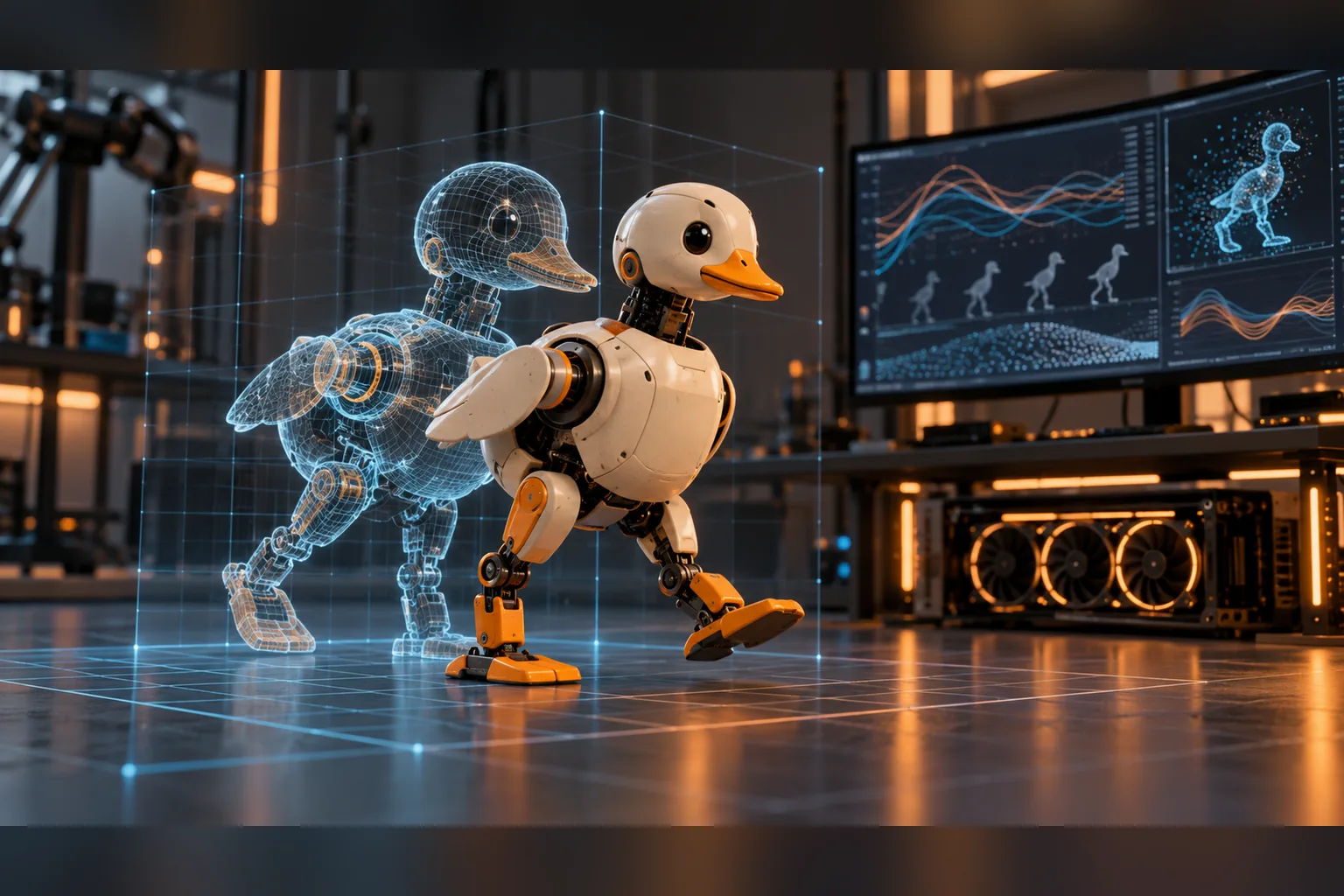
The best robot for reinforcement learning is the one that lets you complete a full experiment loop: simulate, train, evaluate and deploy. Microduck is the clearest assembled sim-to-real choice. Open Duck Mini v2 is stronger when you want the complete open build. LeRobot SO-101 shifts the experiment to manipulation, Petoi Bittle X is a flexible classroom base, and Unitree Go2 raises the budget and scale.
We make Microduck, so this comparison uses segmented recommendations instead of naming one universal winner. Prices were checked on 27 October 2026 and exclude tax, shipping and optional compute.
What matters most in a reinforcement-learning robot?
A demo video of a walking policy is not enough. Check whether the project gives you the environments, reward or imitation workflow, compute guidance, evaluation tools and a reliable path from a trained policy back to hardware.
| Requirement | Why it matters |
|---|---|
| Simulation environment | Lets you train and debug before hardware time |
| Reproducible training code | Avoids rebuilding the whole stack from papers |
| Policy export path | Turns a checkpoint into something the robot can run |
| Onboard inference | Determines how the policy behaves without a host computer |
| Safety and recovery | Makes physical experimentation practical |
| Hardware openness | Controls repair, modification and future research |
How did we evaluate these robots for RL?
We evaluated five platforms through their official documentation on 27 October 2026. The assessment covers available simulation and training paths, policy deployment, onboard compute, price, hardware access and the skill each robot lets a learner practise.
This is not a controlled benchmark of final policy performance. Training results depend on the task, reward design, simulator fidelity, random seeds and researcher experience. A robot that publishes fewer claims can still be the better experimental platform.
Quick comparison: robots for reinforcement learning
| Robot | Price signal | Main RL path | Policy deployment | Best fit |
|---|---|---|---|---|
| Open Duck Mini v2 | Under $400 BOM | Open sim-to-real and community training | Open runtime on a built robot | Full-stack robotics research |
| Microduck | $399 | mjlab training and policy workflow | ONNX policies on onboard control loop | Assembled sim-to-real |
| LeRobot SO-101 | $121.94-$229.88 parts | Manipulation data and LeRobot workflows | Host-connected arm workflow | Manipulation and imitation learning |
| Petoi Bittle X | $319-$469 | Custom experiments on an Arduino/ESP32 platform | Programmatic behaviours | Classroom and custom research base |
| Unitree Go2 | Roughly $1,600 entry tier | Commercial SDK and research tooling | Commercial onboard platform | Larger mobile-robot research |
Open Duck Mini v2 - best for a fully open RL build
Open Duck Mini v2 exposes the whole path from mechanical design to runtime. It is a community project built around simulation and sim-to-real experiments, with CAD, a BOM and training resources published.
Why it belongs here: the learner can inspect and alter the mechanical, electronic and software assumptions behind the policy. That makes it a stronger research project than a black-box robot when the body itself is part of the question.
Trade-off: the build can take weeks and the owner supplies integration work. The robot is roughly 42 cm with legs extended, and the official sub-$400 figure is a BOM target, not a complete project budget.
Best for: researchers and makers who want to own every subsystem and are comfortable debugging across mechanics, electronics and ML. Start with the build-cost guide and buy-or-build comparison.
Microduck - best for assembled sim-to-real experiments
Microduck publishes an Apache-2.0 software stack with a simulator, mjlab training environments, an ONNX policy contract and an onboard 50 Hz control loop. Seven trained behaviours provide a working baseline.
Why it belongs here: the hardware arrives assembled and calibrated, while the policy layer remains available for inspection and training. That reduces the gap between an ML experiment and a working robot.
Trade-off: the hardware design is not fully open, and the compact duck imposes real constraints on sensors, payload and available workspace. Training still requires suitable CUDA hardware or hosted compute.
Best for: people who want to learn locomotion, reward design and sim-to-real validation without first building a robot. Follow the training guide, then review the compute requirements.
LeRobot SO-101 - best for manipulation RL
SO-101 is an open robot arm built for the LeRobot ecosystem. A leader-follower setup supports demonstrations and physical manipulation experiments, which is a different learning target from a walking policy.
Why it belongs here: manipulation turns the experiment into a visible object-level task. You can collect demonstrations, train a policy and test whether the gripper generalises beyond the demonstration setup.
Trade-off: the core workflow is teleoperation and imitation learning rather than a packaged legged-RL course. Users need to print or source parts, assemble the arm and verify the current training support in their chosen LeRobot release.
Best for: manipulation, grasping and imitation-learning projects. Compare it with Microduck in the legs-versus-arms guide.
Petoi Bittle X - best for a flexible classroom research base
Bittle X is a small quadruped with Arduino/ESP32 hardware, an open software framework and a mature education ecosystem. It is easier to initialise for students than a research robot that assumes a full ML toolchain.
Why it belongs here: custom projects can start with familiar programming patterns and later add sensing, optimisation or learning components. The stable four-legged platform keeps the first experiments manageable.
Trade-off: the product is not sold as a complete reinforcement-learning course, and its standard compute is not a drop-in GPU training station. An instructor will need to design the experiment and connect it to a separate training workflow.
Best for: classrooms that want a robust low-stakes robot before moving to a dedicated RL platform. The direct Microduck vs Bittle comparison covers the distinction.
Unitree Go2 - best for a larger research budget
Go2 is a commercial quadruped platform with an SDK, richer mobility and a larger physical scale. It is a step up when the experiment requires room-scale navigation, stronger payloads or an established commercial platform.
Why it belongs here: the larger robot makes navigation, terrain and dynamic movement experiments possible in environments where a desk robot is too small. Developer access makes custom integration realistic.
Trade-off: the entry price is roughly four times Microduck, and costs and capabilities vary by configuration. Hardware access remains commercial rather than fully open.
Best for: funded labs and teams whose research question genuinely requires a larger quadruped. Do not buy it to learn the first RL loop.
Which reinforcement-learning robot should you choose?
Choose by the experiment you can repeat:
- Train and deploy a walking policy this month: Microduck.
- Build the body and study the full stack: Open Duck Mini v2.
- Learn from demonstrations and manipulate objects: LeRobot SO-101.
- Bring RL into a classroom or test custom sensing: Petoi Bittle X.
- Run room-scale or commercial-platform research: Unitree Go2.
The best evidence is a completed loop: a reproducible simulation, a recorded training run, a separately evaluated policy and a safe hardware test. A robot without that loop is a development project, not yet an RL result.
Best robots for reinforcement learning FAQ
What is the best robot for reinforcement learning in 2026? Microduck is the clearest assembled sim-to-real option. Open Duck Mini v2 is better when complete hardware access matters.
Do I need an NVIDIA GPU? A CUDA-capable NVIDIA GPU is recommended for serious local policy training. Hosted Hugging Face Jobs can replace local GPU ownership.
Can I train a policy without hardware? Yes. Microduck's simulator is available before the robot arrives. Physical validation is still necessary because a simulation policy can fail under real-world dynamics.
Which robot is best for manipulation? LeRobot SO-101 is the manipulation-specific choice in this set.
Which robot is more open? Open Duck Mini v2 publishes the broader mechanical and software stack. Microduck publishes its software and training environments but not complete hardware manufacturing files.
Key takeaways
- Reinforcement learning requires a loop, not just a robot that appears in a policy demo.
- Microduck offers the shortest assembled path to a deployable walking policy.
- Open Duck Mini v2 is the stronger full-stack build and research project.
- SO-101 changes the objective to manipulation; Bittle X is the classroom base.
- Unitree Go2 is a larger-platform decision with a correspondingly larger budget.
- Train in simulation, evaluate separately and validate every hardware policy under supervision.
Where to go next
- How to train Microduck - the full workflow
- Microduck simulator - start without hardware
- Microduck policies - ONNX, skills and deployment
- Best Python robot kits - compare programming paths
- Pre-order Microduck - the assembled walking platform