
Microduck on Hugging Face: Models, Spaces and SDK
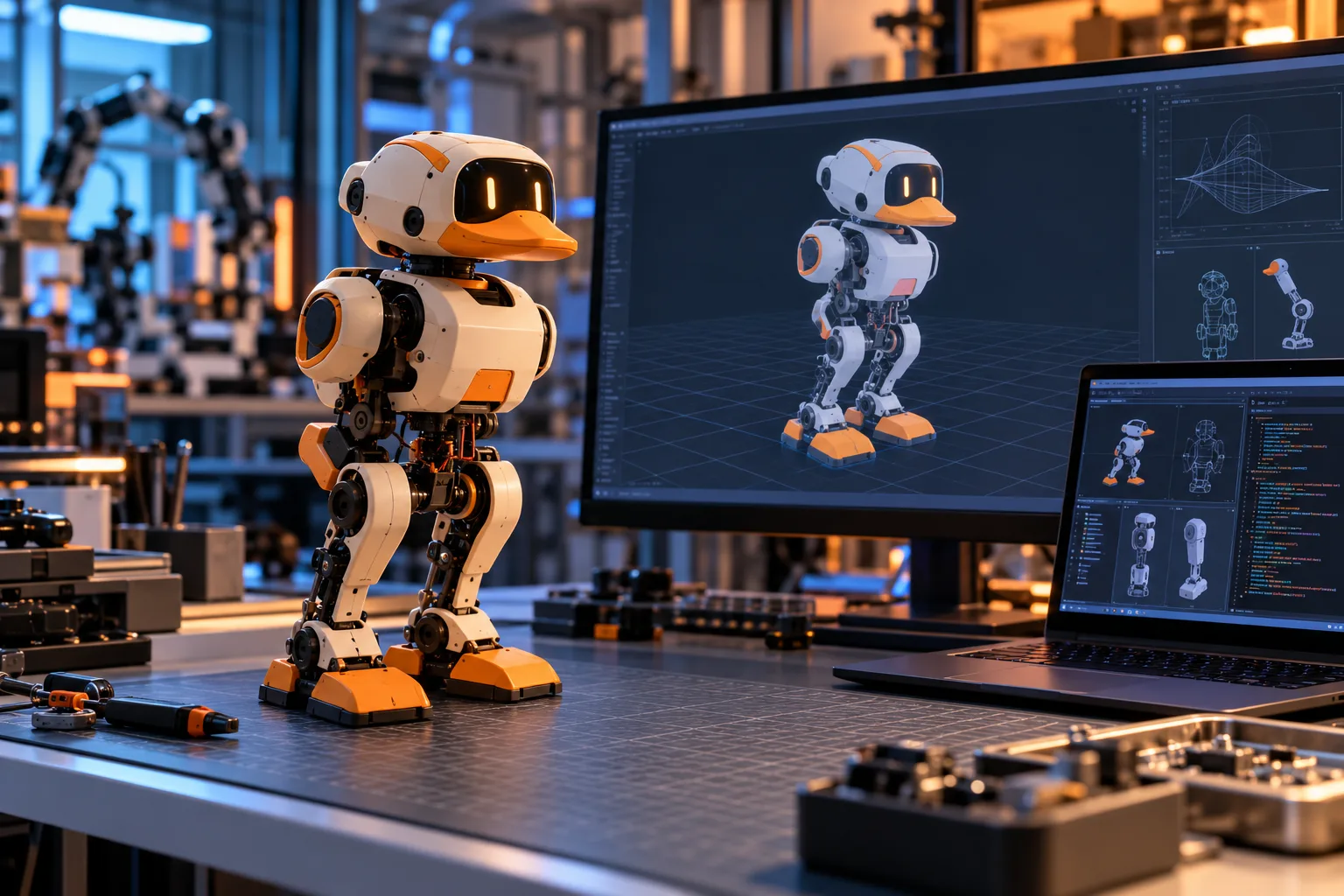
Yes, Microduck is on Hugging Face through the verified pollen-robotics organization. The public resources include the official browser simulator, policy model repository, Arena and training-related datasets; the physical robot is still sold only at microduck.homes, not through Hugging Face. Hugging Face hosts the software and model layer. Pollen Robotics makes the robot.
That split is the key to reading search results about “Microduck Hugging Face”, “Hugging Face Microduck” or a “Microduck Hugging Face price.” This page maps the official resources, explains what can be tried without hardware and separates community projects from the organisation that publishes the robot.
Is Microduck made by Hugging Face or Pollen Robotics?
Microduck is made by Pollen Robotics, the Bordeaux-based robotics company that joined Hugging Face in April 2025 and forms its robotics team. Hugging Face is therefore part of the product story and hosts the open collaboration layer, while Pollen Robotics remains the maker named on the Microduck project, GitHub repositories and checkout.
The relationship explains both names appearing together in launch coverage. It does not create a separate “Hugging Face robot edition,” and Hugging Face is not the physical robot’s retail checkout. The official 25 cm duck is listed at $399 before taxes and shipping on microduck.homes.
Pollen Robotics is also the company behind Reachy Mini. Microduck is its second consumer robot and focuses on a different job: walking, balancing and retrainable locomotion rather than face-to-face interaction. The about page covers the maker’s history; Microduck vs Reachy Mini explains the product split.
What official Microduck resources are on Hugging Face?
The verified Pollen Robotics organization hosts several official Microduck resources for simulation, policies and experimentation. These are the sources to use when you want to try the robot in software or understand the public model layer.
| Resource | Official location | What it is for |
|---|---|---|
| Microduck Simulator | pollen-robotics/microduck-simulator Space | Drive a simulated Microduck in the browser without buying hardware |
| Microduck Policies | pollen-robotics/microduck-policies model | Inspect the published policy artefacts and understand the official behaviour layer |
| Microduck Arena | pollen-robotics/microduck-arena Space | Explore a shared Space built around Microduck behaviours and challenges |
| Microduck Emotions Dataset | pollen-robotics/microduck-emotions dataset | Published data associated with the Microduck project |
| Policy Playground | pollen-robotics/microduck-policy-playground Space | An additional official Space for policy-focused experimentation |
The namespace matters. An organisation-verified resource begins with pollen-robotics/. A personal account can publish a Microduck policy, simulator fork or experiment, and those community projects can be useful, but they are not automatically official documentation. Check the publisher name before treating a model as supported.
The official Hugging Face organisation also hosts broader robotics work from Pollen Robotics, including Reachy Mini resources. Do not assume every repository with “robot” in its name supports Microduck hardware.
Can you try Microduck without buying the robot?
Yes. The official Microduck Simulator is a Hugging Face Space, so a modern browser can drive and inspect a simulated robot without a local GPU or physical Microduck. The hosted Space can be slower to start after inactivity, but it remains the shortest way to see the behaviour before hardware arrives.
The simulator is not only a promotional animation. Microduck’s policies are trained in simulation and then transferred to hardware, so the hosted Space and the local simulator expose the same general workflow. You can observe the robot’s movement, begin learning how commands map to behaviours and then follow the local simulator guide when you need more control.
This is why the browser Space is useful to teachers, prospective buyers and developers. A classroom can open a shared link with no installation. A developer can inspect the experience before setting up Python, CUDA or a training environment.
Driving the simulated robot is not proof that a new policy is safe on real hardware. Simulation remains a model. Friction, motor heating, sensor noise and unmodelled contact can change the result. The sim-to-real guide covers that gap, and robot policy evaluation describes the evidence needed before physical testing.
Where are the official Microduck policies and training resources?
The official policy artefacts are published in the pollen-robotics/microduck-policies Hugging Face model repository. The code that runs the robot is in the Microduck GitHub repository, while the reinforcement-learning environments are in microduck_rl.
Those layers serve different purposes:
- Hugging Face model repository - published policy artefacts and model discovery.
- GitHub robot repository - runtime, Python SDK, simulation and deployment tooling.
- GitHub training repository - mjlab-based reinforcement-learning environments, training code and export workflow.
- Hugging Face Jobs - hosted compute for training when you do not own a suitable local GPU.
The Microduck GitHub guide is the source map for the code, while the policies guide explains how policy files are installed, replaced and published safely. If you want to train rather than use a shipped behaviour, follow how to train Microduck and review the training compute requirements.
A policy appearing on Hugging Face does not make it manufacturer-verified. Community policies may use different observations, actions or training assumptions. Use the robot’s documented shape checks, keep an official policy available for reset and test a new policy on a stand before placing the robot near an edge.
Does the Microduck Dev pack include Hugging Face credit?
Yes. The Dev pack costs $119 and includes three spare motors, five motor cables, two batteries, a dual charger, ten NFC tags, a screwdriver, a screw pack and a Hugging Face credit. The credit is relevant to hosted training workflows, not to driving a finished robot.
The standard robot, Charger pack and Accessory pack do not require a Hugging Face account to walk or play. Microduck runs its trained policies onboard, and the included controller works without a laptop or cloud connection. Hugging Face becomes important when you choose to use its Spaces, models, Jobs or community resources.
The accessories guide compares the packs, and Microduck cost separates the robot price from optional training compute.
Does Hugging Face sell the physical Microduck robot?
No. Hugging Face hosts the official simulator, model and community layer; the physical robot is sold directly by Pollen Robotics at microduck.homes. The pre-order is $399 before taxes and shipping, with four colourways and optional packs, and payment is handled once through the official checkout.
Do not treat a Hugging Face profile, a Space, a model card or a marketplace listing as a checkout page. Before paying, verify that the store identifies Pollen Robotics, describes the 25 cm Microduck robot and calculates taxes and shipping in the official checkout.
The where-to-buy guide explains the ordering steps. The official-source checklist is the short safety check for links found through search, social media or community posts.
Why do people search for Microduck on Hugging Face or Reddit?
People search Hugging Face for the simulator, models and open-source workflows, and search Reddit for owner discussion, delivery experiences and independent opinions. Those sources answer different questions: Hugging Face is where project artefacts are published; Reddit is an outside conversation that the maker does not control.
For a product fact such as price, contents, dimensions or software support, use the official store, specs page, GitHub repositories and Hugging Face organisation. For a reproducible software issue, use the relevant GitHub issue tracker. For community experience and hardware advice, the Pollen Robotics Discord and outside forums can help, but a comment is not a manufacturer guarantee.
This distinction matters when a search result mixes community models with official ones or repeats a price from launch week. Verify the namespace, date and source instead of assuming that every Microduck-named repository or discussion describes the current product.
How do you tell official Microduck projects from community projects?
Check the publisher, the linked source and the stated hardware contract. Official model and Space identifiers begin with pollen-robotics/; official software repositories live under the pollen-robotics GitHub organisation. Community projects can be valuable, but they should identify their licence, training assumptions and compatibility with the current robot.
Use four checks:
- Publisher: does the Hugging Face account resolve to the verified Pollen Robotics organisation?
- Source link: does the model card or Space point back to an official repository, documentation page or policy workflow?
- Hardware contract: does it state the observation and action dimensions expected by the robot?
- Support status: is the project maintained by Pollen Robotics or clearly labelled as community work?
A familiar brand name in the title is not enough. A fork may preserve the name while changing the policy, dependencies or safety assumptions. The policies guide describes the shape checks and safe testing path in more detail.
Microduck on Hugging Face FAQ
Is Microduck on Hugging Face? Yes. The verified Pollen Robotics organisation publishes official Microduck Spaces and model resources, including the browser simulator and policy repository.
Is Microduck made by Hugging Face? Pollen Robotics makes Microduck and forms Hugging Face’s robotics team. Hugging Face hosts the open model and collaboration layer; the physical robot is sold by Pollen Robotics at microduck.homes.
Can I try Microduck for free on Hugging Face? Yes. The Microduck Simulator is a hosted Hugging Face Space that runs in a modern browser without the physical robot.
Where are the official Microduck policies? Start with pollen-robotics/microduck-policies on Hugging Face, then use the pollen-robotics/microduck and microduck_rl GitHub repositories for runtime and training code.
Does Hugging Face sell the $399 Microduck? No. The $399 physical pre-order is sold directly at microduck.homes. Hugging Face hosts the simulator and model layer.
Are Hugging Face community Microduck policies safe to run? Community policies are not automatically verified by Pollen Robotics. Follow the documented shape checks, keep an official policy available and test new behaviour on a stand before using it near people or table edges.
Does Microduck need Hugging Face to walk? No. The shipped policies run onboard, and the standard controller can drive the robot without a cloud account. Hugging Face matters for hosted simulation, model discovery and optional training workflows.
Key takeaways
- Microduck is made by Pollen Robotics and appears officially under the verified
pollen-roboticsHugging Face organisation. - The official browser Simulator, Policies model, Arena and related resources are separate from the physical store.
- Hugging Face is useful for free simulation, model discovery and hosted training; it does not sell the robot.
- The physical Microduck costs $399 before taxes and shipping at microduck.homes.
- Community Microduck policies and forks are not manufacturer-verified just because they appear on Hugging Face.
Where to go next
- Microduck simulator - run the official browser Space and learn the local path
- Microduck GitHub - SDK, runtime, simulator and training repositories
- Microduck policies - official and community policy installation
- How to train Microduck - mjlab, reinforcement learning and deployment
- Microduck training compute - local GPU or Hugging Face Jobs
- NVIDIA Microduck - why NVIDIA hardware appears in training searches
- Microduck official sources - verify the seller before paying
- Small biped robot guide - compare the category before choosing
- Pre-order Microduck - the official $399 checkout