
Biped Robot Reinforcement Learning: A Practical Guide
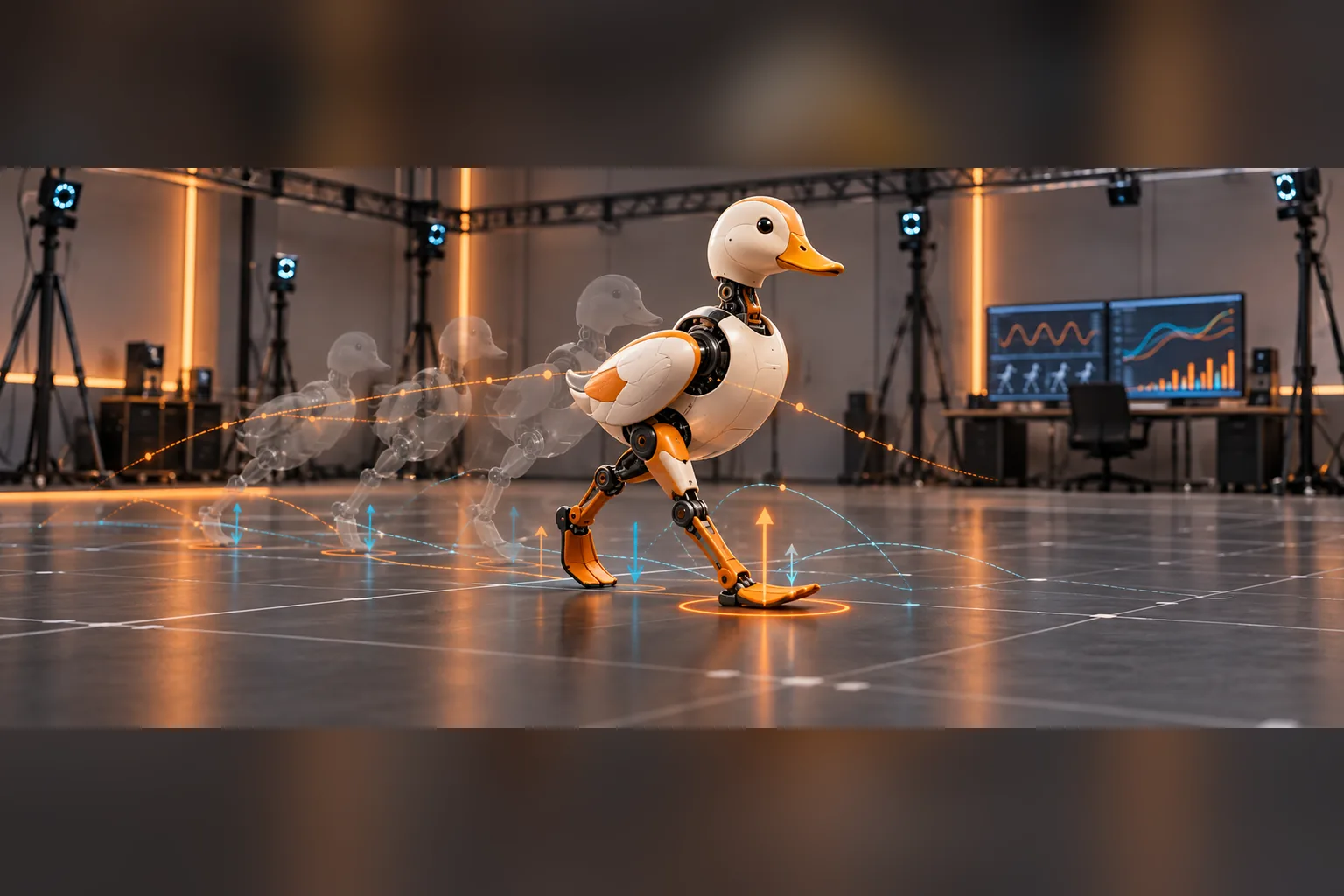
Biped robot reinforcement learning trains a controller to stand, walk and recover by interacting with a simulated robot and maximizing a reward. The hard parts are not the PPO call: they are choosing observations and actions, defining a reward that produces the intended behaviour, randomizing plausible hardware variation and proving that the learned policy transfers safely.
Biped systems make those problems visible because balance depends on continuous contact changes. A controller can appear to walk while relying on unrealistic friction, perfect sensors or a starting pose that real hardware cannot reproduce.
Why is reinforcement learning for biped robots difficult?
Reinforcement learning for biped robots is difficult because balance is under active control, contacts change discontinuously and small model errors can accumulate into a fall. A stable policy must coordinate legs, body pose and command tracking while respecting torque, velocity and thermal limits.
The reward also creates risk. Optimizing forward speed alone can produce a policy that lunges and falls. Penalizing every deviation too heavily can produce a policy that barely moves. Reward design turns the desired behaviour into a measurable trade-off.
What does a biped RL system need?
A reproducible system separates five parts:
| Component | What it must define |
|---|---|
| Robot model | Geometry, mass, joints, actuators, sensors and control rate |
| Simulation task | Starting state, episode length, terrain and termination rules |
| Observation | Proprioception, commands and any allowed perception inputs |
| Action | Joint targets, residual controls or another bounded interface |
| Evaluation | Task metrics, safety gates and held-out scenarios |
Microduck, for example, uses mjlab with MuJoCo Warp for training and exports ONNX policies for its onboard 50 Hz runtime. Its current policy family maps 61 observations to 14 joint targets. Exported policies retain the observation normalizer and are checked against the runtime contract.
How do you design a reward for biped locomotion?
Design the reward around the behaviour and safety constraints you can actually evaluate. Start from a working task and change one term or weight at a time.
- Task reward: forward speed, heading or commanded velocity tracking.
- Upright reward: body orientation and height inside the allowed range.
- Gait shaping: foot clearance, swing timing or contact pattern when needed.
- Energy and smoothness: torque, joint velocity and action-change penalties.
- Safety penalties: falls, self-collision, joint-limit violations or unsafe termination.
- Recovery reward: time to regain a valid stance after a disturbance.
A reward that favours speed but ignores stability produces a policy optimized for a different task than the one written in the specification. Watch replays, not only the learning curve.
Why does curriculum matter for walking policies?
A curriculum moves from easier tasks and conditions to harder ones as the policy improves. It can introduce rough terrain, stronger pushes, longer episodes, more varied commands or tighter tracking tolerances over training.
The curriculum should reflect the intended operating envelope. Training only on flat, high-friction ground and adding rough terrain at the final checkpoint does not give the policy time to adapt. Conversely, starting with every disturbance at maximum strength can prevent any useful gait from forming.
How should you randomize a biped simulation?
Randomize plausible uncertainty in actuators, contact, timing and initial conditions. For a small biped, the relevant categories often include:
- motor strength, friction and backlash;
- battery voltage and torque availability;
- observation and command delay;
- floor friction and mild terrain variation;
- link mass and centre-of-mass offsets;
- sensor bias, noise and short dropouts;
- initial joint offsets and body orientation.
Randomization expands the training distribution, but it does not repair a wrong action mapping or an unmodelled actuator. Use systematic policy evaluation to determine which difference actually causes the transferred policy to fail.
How do you deploy a learned walking policy?
Deploy through a ladder:
- Confirm the ONNX observation and action shapes.
- Replay the policy in the training simulator.
- Test held-out scenes, starts and disturbances.
- Run the deployment runtime without free-floor movement.
- Put the robot on a stand and verify start, stop and reset.
- Run short supervised floor trials inside a clear safety area.
- Increase duration and scenario diversity only after repeatable clean runs.
Keep the manufacturer’s shipped policy available for comparison and recovery. A custom gait should be treated as an experiment even when the simulation results are strong.
Which biped RL setup fits your project?
Choose by the part of the stack you want to own:
- Assembled sim-to-real learning: Microduck provides a working biped, Python SDK, simulator and published training workflow. It is the shortest route to studying policies on physical hardware.
- Full mechanical and software build: Open Duck Mini v2 publishes a broader design and build stack. It suits projects where building and modifying the robot are central.
- Humanoid interaction and gestures: a conventional humanoid kit may fit better when the goal is a packaged humanoid experience rather than an open locomotion-policy workflow.
- A larger research platform: full-size humanoids or quadrupeds require a different budget, safety process and lab footprint.
The Microduck training guide is the concrete implementation path. The RL robot comparison covers current platform trade-offs without treating one robot as universally best.
What should you train first?
Start with a behaviour that is easy to observe and score:
- stand with a stable body pose;
- track a slow forward velocity;
- turn in place;
- recover from a small push;
- maintain a walk at two commanded speeds.
Leave tricks and high-speed movement until the evaluation harness can measure failures reliably. A policy that walks slowly but consistently provides a better baseline than an impressive demo that cannot be repeated.
Biped robot reinforcement learning FAQ
What is biped robot reinforcement learning? It trains a control policy that helps a two-legged robot balance, walk or complete another task through simulated experience and a reward signal.
Do I need a GPU? A CUDA-capable GPU is the practical choice for serious parallel simulation and training. Small experiments, evaluation and deployment checks can use less compute.
Can a biped policy train entirely in simulation? Much of the workflow can, and the shipped Microduck policies follow a sim-to-real path. Physical transfer still requires evaluation and supervised testing.
Why does a walking policy fall on a real floor? Contact, friction, actuator response, delay and sensor noise can differ from simulation. The failure may be a model error, a reward that learned the wrong behaviour or an integration mismatch.
How do I keep custom policies safe? Validate the policy contract, test on a stand, keep an operator stop available and retain the official policy as the reset baseline.
Can I start without robot hardware? Yes. The simulator supports driving, policy replay and training before hardware arrives.
Key takeaways
- Biped RL needs a full experiment loop, not only PPO training code.
- Reward design and curriculum determine which gait the policy learns.
- Randomization should represent plausible actuator, contact and timing variation.
- Validate the exported policy contract before hardware testing.
- Use bench and supervised floor gates instead of jumping from simulation to free movement.
- Keep the shipped policy available as a safe comparison and recovery path.
Where to go next
- Sim-to-real robotics - model and transfer the learning loop
- Robot policy evaluation - benchmark success and safety
- How to train Microduck - the concrete biped workflow
- Best robots for reinforcement learning - compare platforms
- Microduck for AI research - plan a lab-scale study