
Best Raspberry Pi Robot Dog Kits in 2026: 5 Compared
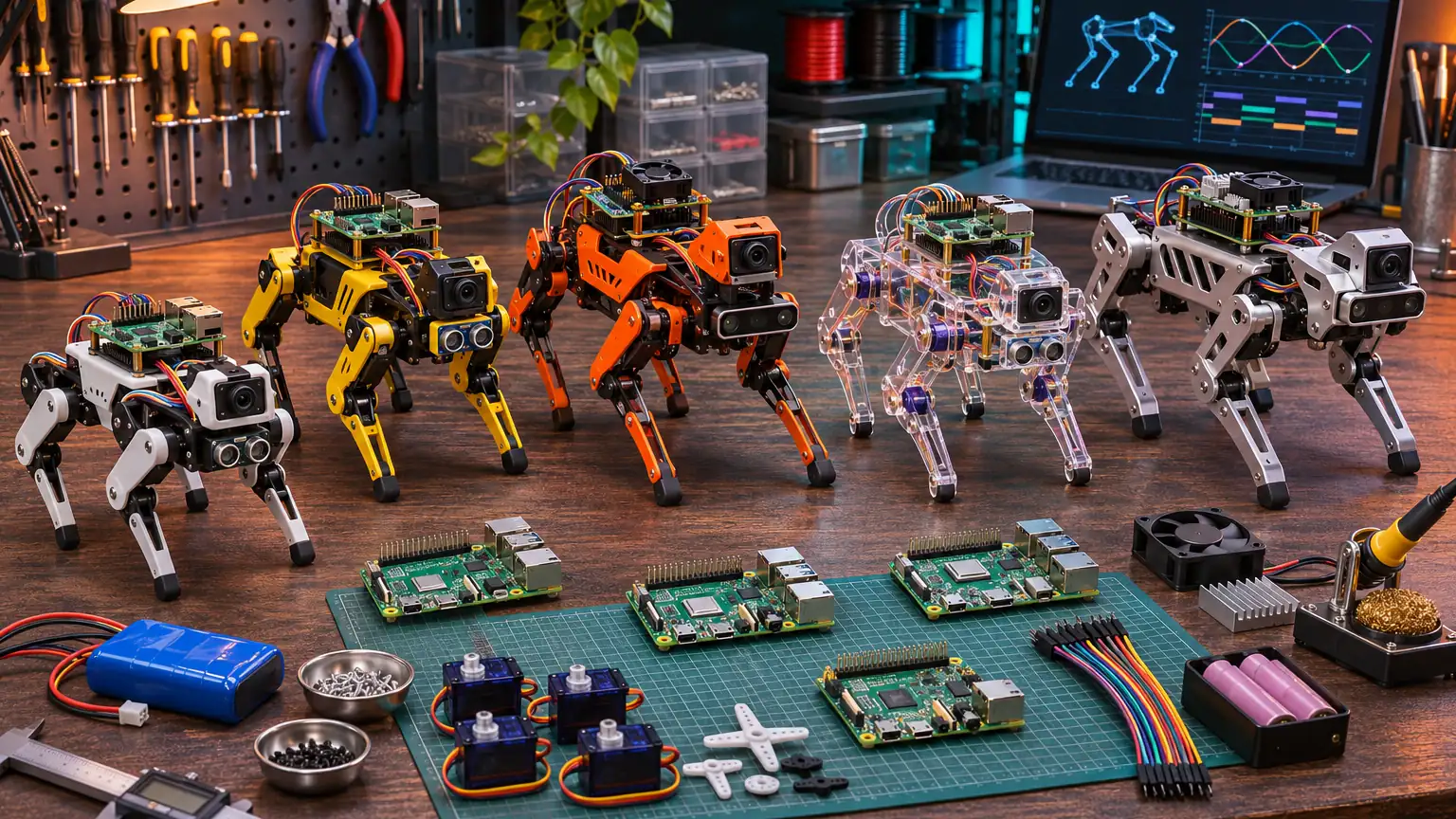
The best Raspberry Pi robot dog kit for most developers is Mini Pupper 2. It combines a Pi-powered kit, Apache-2.0 ROS 2 software, current SLAM examples and a documented upgrade path. For a lower-cost AI and interaction project, choose SunFounder PiDog; for a more turnkey Pi 5 and ROS platform, choose Hiwonder PuppyPi; for the cheapest assembly project, choose Freenove; and for an ESP32 motion controller paired with Pi 4B vision, choose WAVEGO.
This guide compares the hardware you actually receive. The official MangDang store listed Mini Pupper 2 at $649 pre-assembled, $604 with pre-assembled legs and $399 for the upgrade kit plus a CM4102000. SunFounder listed PiDog at $179.99 without a Raspberry Pi, Freenove listed its robot dog at $129.99 without a Pi or batteries, Hiwonder listed PuppyPi from $589.99, and Waveshare listed WAVEGO from $242.99 to $415.99 depending on configuration.
Those prices are not directly equivalent. Some include the computer, battery, camera or assembly; others do not. We checked the official product pages on 13 November 2026 and treated every “from” price as a starting configuration until the selected bundle proved otherwise. Taxes, shipping, tools and consumables are excluded unless stated.
This is a documentation and store-configuration comparison, not a controlled test in which five robot dogs ran the same route. If your requirement is software or hardware openness instead of a Raspberry Pi board, use the separate best open-source robot dogs comparison. That page ranks projects by licences, CAD, BOM and reproducibility; this page asks which Pi kit has the right hardware, software and complete buying path.
SunFounder, Freenove, Hiwonder and Waveshare did not sponsor or review this article. Microduck is made by Pollen Robotics, which publishes this site. We disclose that relationship where Microduck appears as a non-Pi alternative.
What is the best Raspberry Pi robot dog kit in 2026?
Mini Pupper 2 is the best overall Raspberry Pi robot dog kit for a developer who values a maintained ROS 2 path and a documented, compact quadruped. It is not the lowest-cost route and a buyer must confirm exactly which compute module, battery, camera and Lidar are in the selected kit, but it provides the clearest balance of supported hardware and open software in this group.
The best choice changes with the goal:
- Best overall Pi and ROS 2 platform: Mini Pupper 2.
- Best value AI and interaction project: SunFounder PiDog.
- Best turnkey Pi 5 and ROS platform: Hiwonder PuppyPi.
- Best low-cost assembly project: Freenove Robot Dog Kit.
- Best budget ESP32 and Pi 4B hybrid: WAVEGO.
- Best choice when a quadruped is not required: Microduck, an assembled biped with Python and reinforcement-learning tooling.
How did we compare these Raspberry Pi robot dog kits?
We compared the current official kit price, included and missing hardware, supported Pi models, assembly burden, servo and sensor configuration, programming path, ROS support, available documentation and the realistic first project.
“Raspberry Pi robot dog” can describe three different architectures. Mini Pupper 2, PuppyPi, PiDog and Freenove use the Pi as the main computer. WAVEGO splits motion control to an ESP32 and delegates vision to a Pi 4B. Petoi Bittle X can add Pi projects, but its core motion controller is an ESP32, so it is not ranked as a Pi-native kit here.
The price column is the official starting price, not an estimated all-in total. A kit that omits the computer, storage, power supply, batteries or charger can look cheaper before configuration and still cost more after those items are added. Buyers should compare the exact cart contents rather than the headline price.
Which Raspberry Pi robot dog kit fits your project?
Choose Mini Pupper 2 for ROS 2 and documented development, PiDog for AI interaction on a lower initial budget, PuppyPi for a more complete Pi 5 ROS kit, Freenove for the lowest-priced assembly project and WAVEGO for an ESP32 motion stack with Pi vision.
| Project | Official price signal | Raspberry Pi and battery status | Best fit |
|---|---|---|---|
| Mini Pupper 2 | $649 pre-assembled; $604 legs pre-assembled; $399 upgrade plus CM4102000 | Pi/CM4 configuration; confirm the selected kit's battery and accessories | Supported ROS 2 development and ownership |
| SunFounder PiDog | $179.99 | Raspberry Pi not included | AI demos, sensors and interactive learning |
| Hiwonder PuppyPi | $589.99 and up | Standard kits include a Pi 4B 4GB or Pi 5; configurations vary | More complete Pi 5 ROS vision platform |
| Freenove Robot Dog | $129.99 | Raspberry Pi and two 18650 batteries not included | Lowest-cost guided assembly |
| WAVEGO | $242.99–$415.99 | ESP32 motion controller plus Pi 4B vision; bundle dependent | Budget vision demos and hardware expansion |
Is Mini Pupper 2 worth the premium?
Yes, if a current ROS 2 workflow and a supported four-legged platform are worth more than the lowest purchase price. MangDang documents the Mini Pupper 2 software around Ubuntu, ROS 2 Humble, SLAM, Nav2 navigation, visual tracking, multi-robot exercises and generative-AI examples. The robot can be bought pre-assembled, with pre-assembled legs or as an upgrade path.
What does Mini Pupper 2 include?
The official store's $649 Pre-assembled Kit is the least ambiguous finished-robot option in this comparison. The $604 Legs Pre-assembled Kit leaves more work to the buyer, and the $399 Upgrade Kit + CM4102000 is an upgrade rather than a complete second robot for every buyer.
Confirm whether the chosen configuration includes the CM4, camera, Lidar, battery, charger and any fasteners or tools needed for the remaining assembly. A $399 upgrade configuration should not be compared with a $649 delivered kit as though both were the same product.
What are the trade-offs?
Mini Pupper 2 is a product kit built around an open development platform, not a promise that every mechanical, electronic and vendor-specific part can be reproduced from open files. Buyers who need a fully self-sourced machine should inspect the licence, mechanical release, PCB information and BOM for the exact revision before ordering.
The ROS ecosystem is the reason to pay more. If the plan is to wave at the robot from a phone and never inspect a message topic, a lower-cost demonstration kit is likely enough. Developers who intend to explore SLAM or navigation should budget for the official Lidar path and verify third-party sensor support rather than assuming any Lidar will work without integration.
Who should choose Mini Pupper 2?
Choose Mini Pupper 2 when ROS 2, Nav2 and a documented quadruped form factor are central requirements. Start with the official Mini Pupper documentation and Mini Pupper ROS repository before selecting a store variant.
The best open-source robot dogs guide explains where Mini Pupper 2 sits against Petoi, OpenQuadruped, OpenDog and SpotMicroAI. Use that page when software and mechanical openness are the deciding factors.
Is SunFounder PiDog the best AI robot dog for learners?
PiDog is the strongest lower-cost kit here for visible AI and interaction demonstrations. SunFounder describes a Raspberry Pi-powered robot with 12 servos, 32 dog-like actions, a camera, microphone and speaker, ultrasonic sensing, touch, a gyroscope and support for OpenCV, MediaPipe, text-to-speech, speech-to-text and multiple language models.
What does PiDog cost?
The official SunFounder listing showed $179.99 for the PiDog kit on 13 November 2026. The Raspberry Pi is not included. Compatibility is listed for Pi 5, Pi 4B, Pi 3B+, Pi 3B and Zero 2 W, but performance and project headroom change dramatically across those models.
For vision and interactive language demos, use a current Pi with enough memory and cooling rather than assuming the cheapest compatible board will provide the same experience. Also verify whether the selected offer includes assembly and the power supply.
What is PiDog best at?
PiDog is strongest at immediate feedback: it sees, reacts, listens, speaks and performs recognizable dog behaviours. That makes it easier to demonstrate an AI interaction loop than a bare servo chassis with a blank Python environment.
The trade-off is architectural. A large collection of demos is not the same as a maintained ROS stack or an open mechanical project. Choose PiDog for supervised learning and interaction-led projects; choose Mini Pupper 2 or PuppyPi when ROS navigation is the goal.
Who should choose PiDog?
Choose PiDog for a student, maker or club that wants a recognizable robot dog and a broad sensor and AI feature set without paying for a full ROS platform. Review the official PiDog listing and calculate the cost of the Pi, storage, power supply and assembly work before buying.
For other small Python-controlled robots, use the best Python robot kits guide. It compares Microduck, Bittle X, SO-101, Reachy Mini, Open Duck Mini and TonyPi by programming objective.
Is Hiwonder PuppyPi the best ROS robot dog kit?
PuppyPi is the most complete Pi 5 path in this comparison when the Standard, Advanced, Pro and Ultimate configurations meet the required sensor and arm set. Hiwonder documents eight coreless servos, a broad-angle camera, Python, OpenCV, app and controller support, and ROS 1/ROS 2 software depending on the Pi model.
What does PuppyPi cost?
The official Hiwonder store listed PuppyPi variants from $589.99 for a Standard Kit with a Raspberry Pi 4B 4GB. Standard kit prices rise with Pi 5 memory, and Advanced, Pro and Pro Ultimate configurations reach higher prices as sensors, accessories, compute or manipulator options change.
That breadth is useful but easy to misread. A Standard kit and a Pro Ultimate kit should not be described as the same product at one price. Identify whether the intended project needs the arm, Lidar, higher-memory Pi 5 or other bundle-specific hardware, then compare that exact configuration.
Which ROS version should a PuppyPi buyer expect?
Hiwonder's product specification says the Raspberry Pi 5 configuration supports ROS 1 and ROS 2, while the Pi 4B configuration is listed for ROS 1. Confirm the current image, tutorial revision and selected kit before assuming a Pi 4B purchase includes the same ROS 2 path as a Pi 5 purchase.
The advantage is that PuppyPi packages more of the robot, compute, camera and software environment together. The cost is higher entry price and more configuration complexity. It is the better choice when ROS and vision are the project, not when the only goal is a low-cost first servo kit.
Who should choose PuppyPi?
Choose PuppyPi when a more complete Pi-based ROS robot dog, an included computer and access to a larger accessory ecosystem justify the premium. Compare the exact standard and upgraded contents on the official PuppyPi product page.
If a smaller, more explicitly open ROS 2 platform matters more than included sensors and a Pi 5 configuration, choose Mini Pupper 2. If the budget is below $200 before the computer, PiDog or Freenove is the practical entry.
Is Freenove the cheapest useful Raspberry Pi robot dog?
Freenove is the lowest-priced kit in this comparison, but it is not the lowest complete cost. The robot must be assembled, and the official listing states that the Raspberry Pi, two 3.7 V 18650 rechargeable batteries, battery charger and Pi accessories are not included.
What does the Freenove kit cost?
The official Freenove store listed the Robot Dog Kit at $129.99 on 13 November 2026. It documents walking, self-balancing, face recognition, ball tracing, ultrasonic ranging, app control, a camera and servo control, with a step-by-step tutorial and Python code.
The Pi recommendation is broad: Pi 5, 4B, 3B+, 3B and 3A+ are listed as main options, while older Pi models and Zero boards need extra parts. Select one supported configuration and include the board, storage, cooling, power accessories and safe 18650 cells and charger in the total.
How difficult is the Freenove build?
The official listing says the robot needs assembly and provides an online tutorial with Python code. That makes it attractive for a guided classroom or a maker who wants the build to be part of the project, but it is the wrong choice for someone expecting a calibrated robot in the first hour.
Assembly also changes the support boundary. Mechanical fit, servo centering, wiring and calibration become part of the buyer's work. Budget time for those steps and verify that the tutorial matches the current hardware revision.
Who should choose Freenove?
Choose Freenove when the project is specifically to assemble, code and troubleshoot a small Pi robot dog at the lowest initial kit price. Review the official Freenove product page and its “not included” list before comparing it with PiDog.
PiDog costs more but adds a larger documented sensor and interaction set. Mini Pupper 2 costs much more but targets a supported ROS 2 development path. Freenove sits between a classroom electronics project and a finished robot platform.
Is WAVEGO still a good budget Pi vision kit?
WAVEGO remains a useful budget choice when the project needs a 12-DOF dog body and Raspberry Pi camera demonstrations rather than a single-board ROS computer. Waveshare documents an ESP32 sub-controller for motion and a Pi 4B as the vision host, with facial recognition, color tracking, motion detection and an MIT-licensed software repository.
What does WAVEGO cost?
The official Waveshare page listed options from $242.99 to $415.99 on 13 November 2026. The product selector includes basic, assembled and Pi 4 kit forms, and the 18650 batteries are not included in the base kit.
The cheapest option is not necessarily the best value. Confirm whether it includes the Pi 4B, camera, expansion board, assembled chassis, charger and required batteries. The highest configuration can approach or exceed a lower-priced Pi kit once a computer and accessories are added.
What is WAVEGO best at?
WAVEGO is best at separating concerns. The ESP32 handles the 12-servo body while the Pi handles higher-level vision. That architecture is a useful introduction to distributed robot control and lets the motion layer continue without making the vision application part of the motor-control loop.
It is less suitable for a buyer who wants one maintained ROS 2 environment across motion and perception. The community and software surface are smaller than either ROS-focused Mini Pupper or the larger Hiwonder platform.
Who should choose WAVEGO?
Choose WAVEGO for a budget vision robot, an ESP32-and-Pi learning project or a kit where camera demos matter more than ROS navigation. Review the official WAVEGO product page and WAVEGO MIT repository before ordering.
Which Raspberry Pi model do you need?
A Pi 5 is the safest choice for camera, language-model, desktop and heavier Python workloads because it has the most headroom in current kits, but it is unnecessary for simple gait demos and can increase power and cooling requirements.
Use this quick mapping:
- Pi 5: vision, multiple models, OpenCV, web apps, language-model integrations and the most current PuppyPi ROS configuration.
- Pi 4B: a practical balance for camera tracking, Python and many packaged demos; verify whether the specific software image supports ROS 2.
- Pi 3B+ or Zero 2 W: lightweight demos only where the vendor explicitly supports the model. Do not assume the same frame rate, inference speed or software image.
The board is only part of the compute budget. Add a reliable power supply or battery path, a quality microSD card or SSD, cooling and the correct camera cable. A fast Pi throttled by an inadequate supply behaves like a slow robot.
What does a complete Raspberry Pi robot dog cost?
There is no single complete price because the kits intentionally leave different items out. Calculate the selected robot kit, Raspberry Pi or Compute Module, storage, power supply, batteries, charger, camera or Lidar not already included, tools, shipping, tax and the value of your assembly time.
| Cost block | What to verify |
|---|---|
| Robot kit | Exact Standard, Advanced, Pro, assembled or construction variant |
| Compute | Pi model, memory, Compute Module or an already installed board |
| Power | Included battery, required 18650 cells, charger and correct plug |
| Storage and thermal | microSD or SSD, cooler and sufficiently rated power supply |
| Vision and navigation | Camera, depth camera or Lidar included with the chosen bundle |
| Assembly and consumables | Fasteners, tools, calibration time, failed parts and replacements |
| Delivery and ownership | Shipping, import charges, tax, warranty and support boundary |
The cheapest headline price can become the most expensive project when the missing Pi, batteries, charger, camera or assembly pushes it above a more complete kit. Compare the checkout contents, not just the product name.
Python or ROS: which software path should you choose?
Choose Python examples for the fastest interaction project and ROS when the intended outcome includes reusable messages, navigation, sensor fusion or a larger robotics ecosystem.
PiDog and Freenove emphasize Python tutorials, app control and packaged demonstrations. WAVEGO combines ESP32 motion software with Pi camera examples. Mini Pupper 2 and PuppyPi are the stronger ROS-oriented options, although their exact ROS versions and supported hardware configurations must be checked.
Python and ROS are not mutually exclusive. ROS 2 nodes can be written in Python, and a product can expose Python while also providing ROS packages. The important question is whether the vendor maintains the complete path for the exact robot revision you are buying.
Before purchase, ask three questions: Does the tutorial match the selected variant? Does the supported OS image work with the included Pi? Can the documented camera, Lidar and control examples be reproduced without replacing the supplied software stack?
Is Microduck a Raspberry Pi robot dog?
No. Microduck is a 25 cm biped robot built around a Rockchip RK3566-class computer, not a Raspberry Pi. It is not part of the five-product list and should not be described as a Pi dog.
It is relevant when the underlying goal is not “build a quadruped” but “buy an assembled open-software robot I can program and train.” Microduck costs $399, ships with 15 motors, a camera, LiDAR, two IMUs and seven trained moves, and supports a Python SDK, simulator and reinforcement-learning workflow. Its hardware design files are not open; its software stack is open source.
Choose Microduck when biped locomotion, policy training and an assembled path matter more than Raspberry Pi compatibility. Read the Microduck robot overview or the best robots for reinforcement learning comparison. Readers who want to inspect the software boundary should start with the Microduck DIY guide.
Compare Microduck and pre-order it if a four-legged Pi project was only one way to reach a programmable locomotion goal.
Are Raspberry Pi robot dogs safe for beginners?
They are suitable for supervised learning, but a small servo robot is still a machine with pinch points, hot electronics and a battery that needs correct handling. Keep the robot on a clear surface, limit speed and torque, secure loose cables and use the vendor's battery and charger specification.
LiDAR, cameras and language-model integrations do not make a robot autonomous in a safety sense. Keep a physical stop within reach, test new behaviours with the robot elevated or restrained when appropriate, and never let a generated command bypass the documented emergency or power controls.
Young builders should follow the vendor's age guidance and adult supervision requirements. A product marketed for STEM learning is not automatically safe for independent use.
Best Raspberry Pi robot dog kits FAQ
What is the best Raspberry Pi robot dog kit overall? Mini Pupper 2 is the best overall kit for ROS 2 and a documented development path. PiDog is the stronger lower-cost AI and interaction kit, while PuppyPi is the more complete Pi 5 package when the higher price is justified.
Which Raspberry Pi robot dog kit is cheapest after buying a computer? Freenove starts lowest at $129.99, but the Pi, two 18650 batteries, charger and accessories are separate. Calculate the configured cart before assuming it beats PiDog or WAVEGO.
Does SunFounder PiDog include a Raspberry Pi? No. The official listing says the Raspberry Pi is not included. It lists compatibility with Pi 5, Pi 4B, Pi 3B+, Pi 3B and Zero 2 W.
Which Raspberry Pi robot dog kit is best for ROS 2? Mini Pupper 2 is the clearest open ROS 2 development platform in this list. Hiwonder PuppyPi is the more complete package, with ROS 2 listed for its Pi 5 configurations and ROS 1 for its Pi 4B configuration.
Is a Raspberry Pi 5 overkill for a robot dog? A Pi 5 is useful for vision, web apps, language-model integrations and heavier Python workloads. A simpler gait demo can use a supported Pi 4B, but the vendor's exact software image and recommended hardware still take priority.
What extra parts do I need beyond the kit? Check for the Pi or Compute Module, microSD or SSD, power supply, batteries and charger, camera or Lidar, tools and fasteners. Freenove and PiDog explicitly omit the Pi; WAVEGO batteries are not included in the base kit.
Is WAVEGO a Raspberry Pi robot dog? WAVEGO is a hybrid. Its ESP32 controls the 12-servo body while a Raspberry Pi 4B handles vision. Confirm which Pi and camera bundle is selected.
Is Microduck a Raspberry Pi robot dog? No. Microduck is a Rockchip-based biped robot. It is an assembled alternative for Python and reinforcement-learning work, not a Raspberry Pi quadruped.
Key takeaways
- Mini Pupper 2 is the best Pi and ROS 2 development kit in this comparison.
- PiDog offers the broadest documented AI interaction package below $200 before the Pi.
- PuppyPi is the more complete Pi 5 and ROS package when its included hardware justifies the price.
- Freenove is the lowest-cost assembly project, not the lowest complete robot after the Pi and batteries.
- WAVEGO separates ESP32 motion control from Pi 4B vision and remains a budget camera-robot option.
- Compare the exact bundle contents. Missing compute, batteries, charger, camera or Lidar changes the ranking.
- Microduck is not a Pi dog; it is a separate $399 assembled biped for Python and policy training.
Where to go next
- Best open-source robot dogs - compare hardware and software openness
- Best Python robot kits - choose by programming objective
- Microduck DIY guide - understand Microduck's open-software boundary
- Microduck robot overview - specs, moves and onboard stack
- Buy Microduck - the $399 assembled biped alternative