
Best Open-Source Robot Dogs in 2026: 6 Quadrupeds Compared
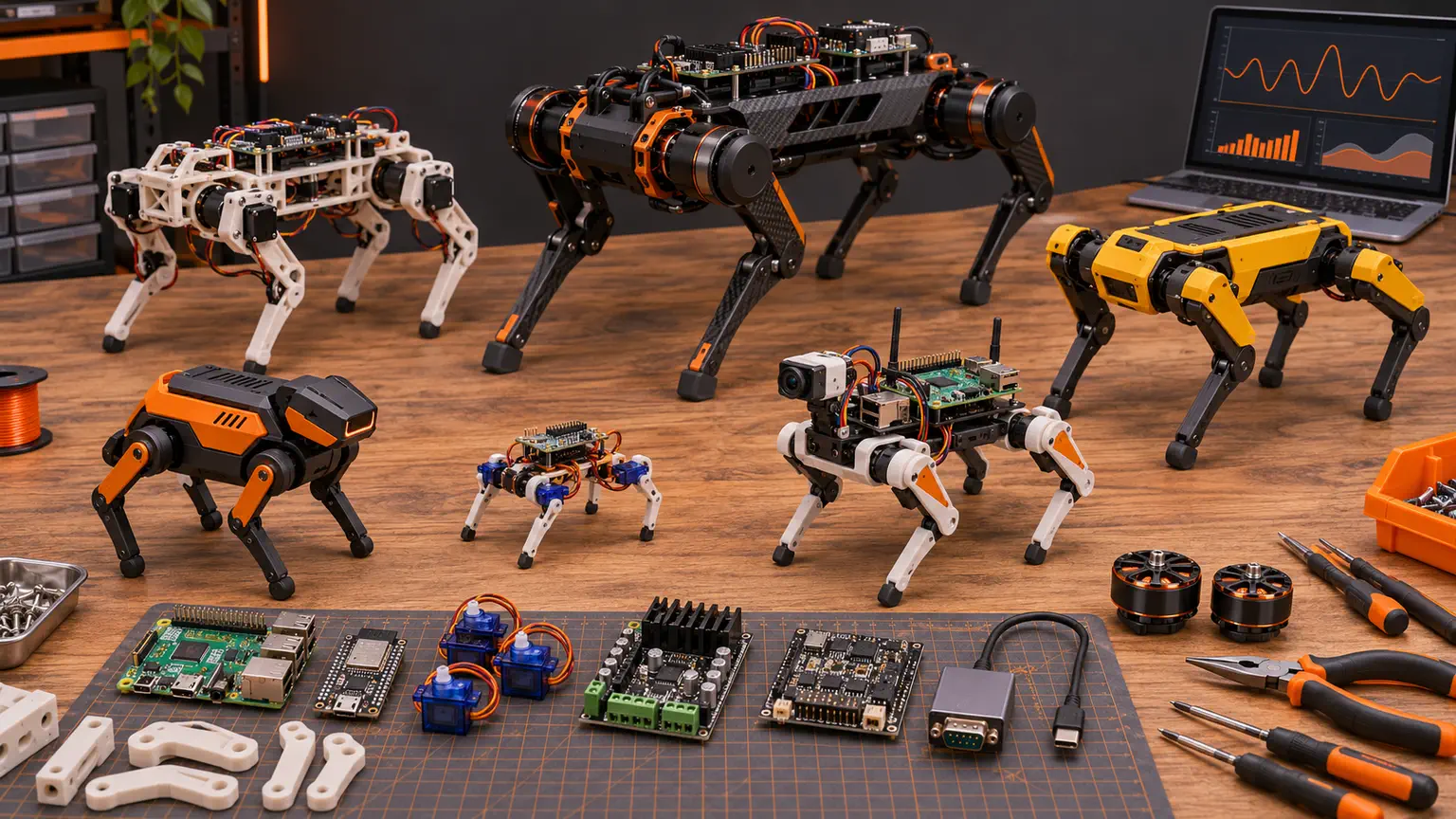
The best open-source robot dog for most developers is Mini Pupper 2. It combines Apache-2.0 ROS 2 Humble software, current SLAM and navigation examples, mechanical documentation and a purchasable pre-assembled kit. The official MangDang store listed the pre-assembled kit at $649, the legs pre-assembled kit at $604 and the upgrade kit at $399 when checked on 12 November 2026.
Choose Petoi Bittle X for the most supported beginner and classroom path, WAVEGO for the lowest-cost integrated ESP32 and Raspberry Pi vision kit, OpenQuadruped for a customizable 12-DOF printed research platform, OpenDog V3 for a larger ODrive and brushless build, and SpotMicroAI for a community PyBullet and ROS route. Stanford Pupper v1 is end-of-life and Pupper v3 is not yet available as a complete current build, so neither is ranked as the best 2026 purchase.
This is a documentation-based comparison, not a controlled test in which six robots ran the same route or terrain. We checked official repositories, manuals, store listings and licences on 12 November 2026. Prices exclude tax, shipping, tools, failed prints, replacement servos and the builder's time unless the manufacturer states otherwise.
If the hardware requirement is specifically a Raspberry Pi and you need to compare included boards, batteries and assembly, use the best Raspberry Pi robot dog kits guide. It treats delivered contents as the main decision, while this page focuses on software and hardware openness.
What is the best open-source robot dog in 2026?
Mini Pupper 2 is the best overall open-source robot dog for a developer who wants a supported four-legged platform and ROS 2. It is not the most open hardware project and not the cheapest, but it balances current documentation, an available kit and a usable software stack better than the alternatives reviewed here.
The right choice changes with the job:
- ROS 2, SLAM and navigation with the least setup friction: Mini Pupper 2.
- A beginner-friendly programmable robot dog: Petoi Bittle X.
- The lowest-priced integrated vision kit: WAVEGO.
- The most flexible 3D-printed project: OpenQuadruped.
- A larger brushless and ODrive build: OpenDog V3.
- A PyBullet, ROS and reinforcement-learning starting point: SpotMicroAI.
How did we judge hardware and software openness?
We treated hardware, mechanical files, firmware, high-level software and the delivered kit as five separate promises. A public control library does not automatically make the motors, PCBs or chassis open. A downloadable CAD package does not guarantee that the obsolete bearings or servo revisions can still be sourced.
Every project had to provide enough public information to answer four questions: can a buyer inspect the mechanism, can a builder obtain or make the parts, can software control the joints and sensors, and can the community reproduce the project from the published revision? We also recorded the controller platform, ROS or simulator support, current kit availability and the type of person most likely to finish the build.
Which open-source robot dog fits your project?
Choose Mini Pupper 2 for ROS 2, Bittle X for the easiest supported start, WAVEGO for budget computer vision, OpenQuadruped for flexible printed hardware, OpenDog V3 for a larger actuator build and SpotMicroAI for simulation-led experimentation.
| Project | Current price signal | Open boundary | Best for |
|---|---|---|---|
| Mini Pupper 2 | $649 pre-assembled; $604 legs pre-assembled; $399 upgrade | Apache-2.0 software, public BOM and mechanical documentation | Best ROS 2 kit |
| Petoi Bittle X | $319–$469 by construction, assembly and servo variant | MIT OpenCat ESP32 framework; finished kit remains a product | Best beginner platform |
| WAVEGO | $242.99–$415.99 | MIT code repository; ESP32 and Raspberry Pi 4B hardware | Best budget vision kit |
| OpenQuadruped | BOM, custom PCB and self-sourced build | MIT software plus attribution requirement; STEP, STL and hardware files | Best customizable DIY project |
| OpenDog V3 | BOM and self-sourced build | MIT CAD, code and BOM | Best larger brushless build |
| SpotMicroAI | Community BOM and self-sourced build | Community hardware files; check each repository's licence | Best simulation and RL reference |
Is Mini Pupper 2 the best ROS 2 robot dog kit?
Yes, among the current kits reviewed here. Mini Pupper 2 is a strong four-legged development platform because the hardware kit, ROS 2 Humble software and accompanying manual are maintained as one documented product path.
The software stack covers Ubuntu 22.04, ROS 2 Humble, SLAM and Nav2 navigation, computer vision tracking, multi-robot coordination and Generative AI examples. The kit can use a Raspberry Pi or a CM4 Compute Module configuration. MangDang publishes mechanical design material, PCB information, a BOM path and a user manual.
What does Mini Pupper 2 cost?
The official store checked on 12 November 2026 showed:
- Pre-assembled kit: $649.
- Legs pre-assembled kit: $604.
- Upgrade kit plus CM4102000: $399.
The labels matter. A $399 upgrade kit is not the same delivered robot as the $649 pre-assembled kit. Confirm whether the chosen option includes the Compute Module, battery, camera, Lidar, charger and any assembly that matters for your project.
What are the trade-offs?
Mini Pupper 2 is an open-source product platform, not a loose collection of every component under a permissive hardware licence. Verify the exact mechanical revision, electronics and BOM before assuming a custom build will match the supported kit. Lidar compatibility is another boundary: MangDang says it can guarantee its official software path for the STL-06P module, while third-party Lidar may require integration work.
Who should choose Mini Pupper 2?
Choose Mini Pupper 2 when ROS 2, a small quadruped, current navigation examples and a supported kit matter more than the lowest price or complete self-sourceability. Use the official Mini Pupper manual and ROS 2 repository before ordering.
Is Petoi Bittle X the best supported beginner robot dog?
Yes. Bittle X is the least intimidating route into a programmable quadruped because the product, tutorials, app, simulator, curriculum and OpenCat community meet at one clearly documented product family.
The current Bittle X uses the ESP32-based BiBoard platform. Petoi documents a 9-DOF Bittle configuration with eight leg servos and one head joint, while BiBoard supports up to 12 servos for broader robot configurations. Firmware can be programmed through Arduino-style tools, and the ecosystem supports block coding, C++, Python projects and Raspberry Pi add-ons.
What does Bittle X cost?
The official Petoi US listing checked on 12 November 2026 ranged from $319 to $469:
- $319: Bittle X V2 construction kit with lite servos.
- $339: pre-assembled kit with lite servos.
- $379: construction kit with alloy servos.
- $399: pre-assembled kit with alloy servos.
- $449: construction kit with alloy servos and arm.
- $469: pre-assembled kit with alloy servos and arm.
The lowest headline price is a construction kit. A classroom or first-time buyer should also budget assembly time and may prefer a pre-assembled variant.
How open is Bittle X?
The current OpenCat ESP32 framework is published under MIT and documents the gait, servo and sensor code. Petoi describes the hardware and software as forkable. The finished robot, mechanical product, tooling and supported kit still come from a commercial platform rather than a fully self-manufactured open design.
That boundary is not a defect. It explains why Bittle X is easier to support than a research project assembled from unrelated repositories.
Who should choose Bittle X?
Choose Bittle X for a first programmable robot dog, a classroom, a supervised young learner or a project where a fast first success matters. Choose Mini Pupper 2 when ROS 2 is the main requirement, or OpenQuadruped when the printed mechanism itself must be the project. The Microduck vs Petoi Bittle comparison contrasts quadruped coding with Microduck's biped policy-training path.
Is WAVEGO the best budget open-source robot dog?
Yes, for an integrated ESP32 and Raspberry Pi vision kit. Waveshare sells WAVEGO as a 12-DOF bionic dog-like robot with ESP32 motion control and Raspberry Pi 4B computer-vision support, and publishes its code under MIT.
The official product page listed $242.99 to $415.99 depending on configuration when checked on 12 November 2026. The listing documents facial recognition, color tracking and motion detection examples, making it the cheapest reviewed path to a complete dog-shaped robot with camera-oriented demos.
What are the trade-offs?
WAVEGO is a product kit with a smaller open-source community than Petoi or Mini Pupper. The controller split and example stack are concrete, but the buyer should confirm which bundle includes the Raspberry Pi, camera, battery and charger. The repository is also much smaller than the broader ROS ecosystems, so advanced navigation or policy work will depend more on the buyer's integration effort.
Who should choose WAVEGO?
Choose WAVEGO when the budget is tight and the desired result is an assembled or near-assembled robot dog with camera demos and an ESP32 control path. Choose Mini Pupper 2 for ROS 2 or OpenQuadruped for a true build. Review the WAVEGO product page and MIT repository before selecting a configuration.
Is OpenQuadruped the best customizable 3D-printed robot dog?
Yes, when the buyer wants a documented 12-DOF printed platform without committing to a single vendor kit. OpenQuadruped provides STEP and STL files, a bill of materials, a custom PCB design, inverse-kinematics material, ROS infrastructure, a URDF and Gazebo simulation.
Its software handles gait generation through Bezier curves, six-axis body-pose manipulation and a three-DOF leg model. The README lists hardware and ROS work as completed while also documenting remaining tasks around gait-to-pose transitions, calibration, gait refinement and reinforcement learning.
What does OpenQuadruped cost?
There is no official finished-robot price. The published BOM and self-sourced electronics determine the total, and the buyer must add printing, tools, PCB fabrication, shipping and spare servos.
That makes OpenQuadruped difficult to compare with a $649 kit. A low parts total can still produce a costly project when the buyer lacks a printer, soldering setup or time for repeated mechanical revisions.
What are the licensing and maintenance caveats?
The repository includes an MIT licence followed by an explicit credit clause. Read the full licence before redistributing a derivative. The code and CAD are public, but the selected servos, PCB fabrication process and mechanical revisions must be sourced and verified.
This is a maintained community project, not a support contract. Pin the repository revision and archive the exact BOM and CAD used for a build.
Who should choose OpenQuadruped?
Choose OpenQuadruped when the mechanism, custom controller and ROS/Gazebo integration are the reason for the project. Choose Mini Pupper 2 when the goal is to use a working robot quickly. Start from the OpenQuadruped repository and its hardware and BOM documentation.
Is OpenDog V3 the best larger brushless robot dog build?
Yes, for a maker who wants a larger printed quadruped and accepts a serious electromechanical project. OpenDog V3 publishes CAD, code and a BOM, with ODrive motor control and AS5047 absolute-position encoders.
The design uses PLA for the printed structure, carbon-fibre foot tubes and custom silicone feet. The repository includes inverse-kinematics demonstrations, walking mode, remote control and instructions for motor calibration and default joint positions.
What does OpenDog V3 cost?
OpenDog V3 does not publish one finished price. The ODrive controllers, brushless motors, encoders, power system, bearings, printed material and fabrication determine the total. It will usually cost more and take longer than a servo kit because the buyer supplies more of the integration.
The published BOM is a starting document, not a promise that every part remains available. Check the exact revision, motor selection and encoder setup before ordering.
Why choose OpenDog over a small servo quadruped?
Choose OpenDog V3 when learning motor control, encoder calibration, power electronics and a larger mechanical structure is part of the objective. A small servo robot is better when the buyer mainly wants to study code and higher-level robot behaviour.
Who should choose OpenDog V3?
Choose OpenDog V3 for a long-form workshop project and for builders comfortable with 3D printing, wiring, calibration and ODrive configuration. It is not a first robot for someone who wants a boxed kit. Review the OpenDog V3 CAD, BOM and code before starting.
Is SpotMicroAI the best simulation and RL community project?
SpotMicroAI is the best starting point in this list when simulation and reinforcement-learning experiments matter more than a polished hardware kit. The project provides a PyBullet environment, gait and terrain randomization, trained RL agents and a ROS interface.
The SpotMicro mechanical concept originated as a community Spot-style quadruped. Builders can choose a simulated robot, a remote-controlled printed build or a Lidar variant. Prints and community builds are distributed across multiple repositories, so the buyer must identify one coherent BOM and software revision.
What are the trade-offs?
SpotMicroAI is a community ecosystem rather than a single vendor-supported product. Some mechanical sources treat licensing differently, and component choices vary significantly across builds. The absence of one fixed price and one canonical kit is the main operational limitation.
For a software-first project, begin with the documented simulation and ROS path. Do not buy a parts list before checking that its CAD, controller and software revision agree.
Who should choose SpotMicroAI?
Choose SpotMicroAI when the first goal is a simulated quadruped and the second is hardware. For a supported kit, choose Mini Pupper 2. For a maintainable ROS learning platform with a complete current manual, SpotMicroAI documentation is best treated as a project archive and community reference.
Is Stanford Pupper still worth buying in 2026?
No. Stanford Pupper v1 is end-of-life and is no longer actively supported by the Stanford Robotics Club. The repository remains useful for study because it documents a Raspberry Pi quadruped, gait scheduling, inverse kinematics and joystick control under an MIT licence.
Stanford says Pupper v3 is fully open source, but complete build instructions were not released at the time of review. Its quick specification mentions Raspberry Pi 5, GIM4305 motors, a depth camera, reinforcement-learning locomotion and roughly a $1,000 BOM target.
A reader searching for a current Stanford Pupper kit should not assume that the v1 BOM or support path is current. Wait for the v3 release or choose Mini Pupper 2 for a supported ROS 2 product.
Are Unitree Go2 and similar robot dogs open source?
No. Unitree Go2 is a commercial quadruped with an SDK and developer access, not a project that publishes complete hardware manufacturing files and a reproducible open BOM.
An SDK can be valuable for a lab that needs a supported larger robot and fast access to a mobility platform. It is a different purchase from the open-source projects in this guide. The best robots for reinforcement learning comparison covers Go2's role in a larger experiment budget.
Do you need a 3D printer to build an open-source robot dog?
Not always. Mini Pupper 2, Petoi Bittle X and WAVEGO offer kit configurations that reduce printing and sourcing. OpenQuadruped, OpenDog V3 and SpotMicroAI assume that the builder can print or order a substantial set of mechanical parts.
Use a print service when quality and turnaround matter more than ownership of a printer. Quote the exact repository revision and material, and assume at least one reprint. A cheap printer quote can still produce an expensive robot if the service cannot meet tolerances or replace failed parts.
Which software stack should you choose?
Choose ROS 2 when transforms, navigation, sensors and system integration are central. Choose OpenCat or an ESP32/Arduino stack when the robot should be easy to program and the code should stay close to the servos. Choose Python, PyBullet and ROS together when reinforcement learning and simulation are the main objective.
Mini Pupper 2 is the clearest current ROS 2 kit. Bittle X is the most accessible product framework. WAVEGO uses ESP32 plus Raspberry Pi vision. OpenQuadruped combines ROS, URDF and Gazebo with a custom controller. OpenDog V3 is lower-level around ODrive and joint calibration, and SpotMicroAI is simulation-first.
What does an open-source robot dog cost?
The current ready-to-buy signal is $242.99–$649. WAVEGO starts at $242.99, Bittle X starts at $319 and Mini Pupper 2 starts at $649 for the pre-assembled configuration.
OpenQuadruped, OpenDog V3 and SpotMicroAI use BOM-led costs. Add the printer or print service, PCB fabrication, motors, drivers, encoders, battery, charger, camera, tools, shipping, tax and replacement parts.
The useful budget is the amount needed for a finished robot that you can calibrate and operate. A parts total that excludes two failed batches of prints or a replacement motor is not a complete project budget.
Are open-source robot dogs safe?
Open-source robot dogs are not automatically safe because they are small or 3D printed. Four moving legs, neck joints, servos, batteries and a wireless controller create pinch, impact and battery risks.
Secure the robot when testing a new gait, keep people and pets outside the movement area and start on a clear floor with conservative speed and torque settings. Balance and test calibration before enabling larger movements. Schools and labs need supervision and a site-specific risk assessment.
Key takeaways
- Mini Pupper 2 is the best current ROS 2 kit, with a $649 pre-assembled option.
- Petoi Bittle X is the easiest supported beginner and classroom platform, from $319.
- WAVEGO is the lowest-cost integrated vision kit, from $242.99.
- OpenQuadruped offers the most flexible documented 12-DOF printed hardware.
- OpenDog V3 is the larger ODrive and encoder project.
- SpotMicroAI is best approached as a simulation and RL reference.
- Stanford Pupper v1 is end-of-life and v3 is not yet fully released.
- Unitree Go2 is a commercial SDK platform, not open hardware.
- Compare the finished cost, support and reproducible revision, not only a BOM.
Best open-source robot dogs FAQ
What is the best open-source robot dog overall? Mini Pupper 2 is the best overall current kit because it combines Apache-2.0 ROS 2 software, current documentation, hardware files and a $649 pre-assembled option.
What is the cheapest ready-to-buy open-source robot dog? WAVEGO starts at $242.99, below Bittle X at $319 and Mini Pupper 2 at $649. Confirm the exact camera, Pi, battery and charger included in the selected bundle.
Which open-source robot dog is best for ROS 2? Mini Pupper 2 is the clearest ROS 2 Humble option, with Nav2, SLAM, vision and multi-robot examples. OpenQuadruped is the stronger choice when a fully configurable printed build matters more than a supported kit.
Which robot dog is easiest for a beginner? Petoi Bittle X is the easiest supported start because the product, OpenCat framework, tutorials, app and classroom material form one ecosystem.
Do I need a 3D printer for an open-source robot dog? Mini Pupper 2, Bittle X and WAVEGO can reduce the printing burden through kits. OpenQuadruped, OpenDog V3 and SpotMicroAI typically require a printer or print service.
Is Stanford Pupper still available in 2026? Stanford Pupper v1 is end-of-life, and Pupper v3 build instructions were not fully released when reviewed. Do not assume the older BOM or support path is current.
Is Unitree Go2 open source? Unitree Go2 is a commercial quadruped with SDK access, not an open hardware design with a complete reproducible manufacturing package.
Are open-source robot dogs safe? They require supervision, conservative speed and torque, secure workspaces, battery care and calibration testing. Public build files do not make a robot safe.
Where to go next
- Best open-source robots to buy - the broader shopping list.
- Best robots for reinforcement learning - compare complete training platforms.
- Robotics reinforcement-learning projects - choose a sim-to-real experiment.
- Sim-to-real robotics - plan policy transfer safely.
- Best open-source robot arms - compare manipulation instead of locomotion.
- Microduck alternatives - compare robots by task and budget.
- Microduck vs Petoi Bittle - choose a biped or programming-focused quadruped.
- Pre-order Microduck - see the $399 assembled biped if policy training on legs is the goal.