
Best Open-Source Robot Arms in 2026: 6 Builds Compared
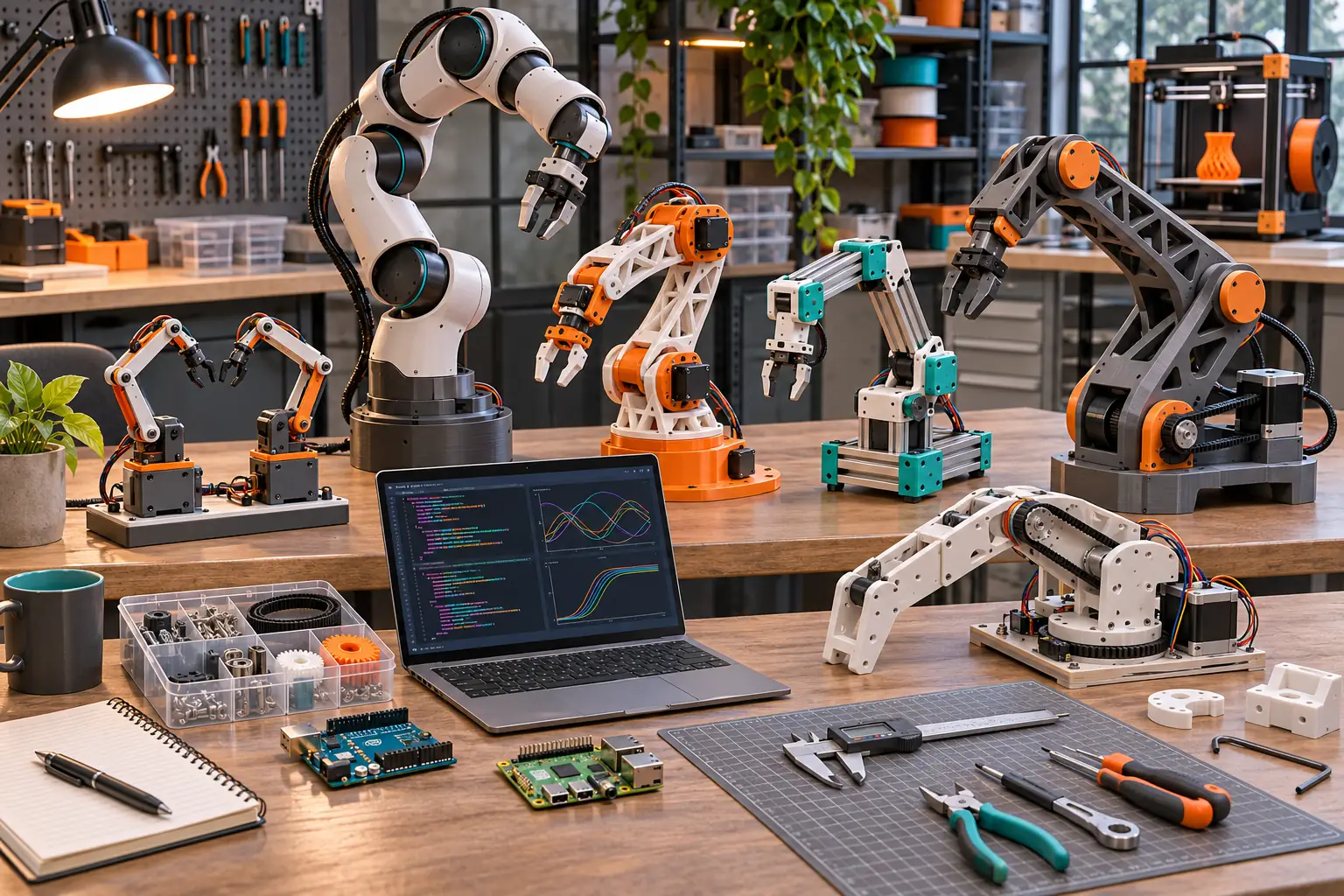
The best open-source robot arm for most AI and manipulation projects is LeRobot SO-101. It has a maintained leader-follower workflow, an Apache-2.0 hardware repository and a documented parts example of $121.94 for one follower arm or $229.88 for a leader and follower pair. Choose OpenArm 2.0 for a more advanced 7-DOF research platform, Thor for an established 6-axis printed arm with a sub-€350 hardware target, Koch v1.1 for a Dynamixel-based alternative, Poppy Ergo Jr for a modular classroom arm, and BCN3D Moveo for a classic fully printed educational build.
This is a documentation-based comparison of publicly available designs, not a controlled test in which six arms performed the same manipulation task. We selected projects with a published bill of materials, visible hardware files and enough software documentation to explain what a buyer or builder must supply. BOM totals and product facts were checked on 9 November 2026.
Microduck is a biped robot, not a robot arm, so it is not ranked here. If your project is locomotion rather than manipulation, use the Microduck vs SO-101 comparison instead.
What makes a robot arm genuinely open source?
An open-source robot arm must publish more than a control script. The minimum useful package includes mechanical files, a bill of materials, firmware or control software and a licence that permits modification. A stronger project also publishes simulation, calibration instructions, printable revisions and an assembly guide.
The open-source boundary needs to be read carefully:
- Hardware licence: STL, STEP, CAD, wiring and BOM rights are separate from software rights.
- Software licence: Apache-2.0, MIT and GPLv3 grant different redistribution and derivative-work terms.
- Component availability: every project depends on proprietary motors, drivers, bearings or fasteners. Open files do not make those parts open.
- Reproducibility: a BOM is useful only when it names the correct revision and still-available parts.
- Buying path: a downloadable build and a supported kit are different products, even when they produce the same arm.
A project can be technically open and still be a poor first choice if the repository is stale, the BOM is empty or the software only runs on an obsolete operating-system image.
How did we evaluate these open-source robot arms?
We compared six projects on the same criteria: hardware and software licences, published BOM quality, number of joints, actuators and controller stack, simulation and AI support, ROS integration, assembly burden, part availability, documentation and community activity.
The list uses best-for-segment ordering, not a universal score. GitHub stars show attention but do not prove build quality, payload accuracy or ease of use. We used repository activity to check whether a project is current, then discounted stars when the software stack, BOM or licence did not match a buyer's task.
The price comparison is deliberately asymmetric. A documented BOM is not a delivered robot, and an official product listing may include printing or assembly that a GitHub repository leaves to the builder. Every price below is a starting signal, not a quote.
Best open-source robot arms at a glance
| Robot arm | Licence boundary | Price signal | Main control path | Best for |
|---|---|---|---|---|
| LeRobot SO-101 | Apache-2.0 repository; proprietary servos | $121.94 follower; $229.88 pair in the official US parts example | LeRobot Python, teleoperation and imitation learning | Best overall AI manipulation route |
| OpenArm 2.0 | Hardware CERN-OHL-S-2.0; software Apache-2.0 | Official BOM; no single finished price | ROS2, MuJoCo, Isaac Lab, Python and teleoperation | Advanced 7-DOF research |
| Thor | CC-BY-SA-4.0 | Official hardware target below €350 | GRBL, RepRapFirmware, ROS2 and G-code | Established 6-axis printable arm |
| Koch v1.1 | Apache-2.0; Dynamixel motors are proprietary | $199 leader and $278 follower in US parts lists | Python leader-follower stack | Dynamixel-based alternative |
| Poppy Ergo Jr | Hardware CC BY-SA 4.0; software GPLv3 | Official BOM; no fixed delivered price | Python and Raspberry Pi | Modular classroom robotics |
| BCN3D Moveo | MIT | BOM and printable files; no official price | Arduino-based controller and firmware | Classic fully printed education project |
1. LeRobot SO-101 - best for AI, teleoperation and imitation learning
SO-101 is the current standard open arm from The Robot Studio and Hugging Face's LeRobot ecosystem. It builds on SO-100 with easier assembly, improved wiring and updated leader-arm motors. The official repository is actively maintained and links sourcing, printable parts, assembly instructions and multiple kit vendors.
What can you program?
SO-101 works directly with LeRobot's Python library. The normal learning path is configure the motors, calibrate each joint, teleoperate the follower with the leader arm, record demonstrations and train a manipulation policy on the resulting dataset.
The protocol is concrete: six STS3215 serial-bus servos in the follower, a leader with differently geared motors and USB-connected motor-control boards. That makes the arm inspectable without requiring a proprietary robot operating system.
What does SO-101 cost?
The official US parts table totals $121.94 for one follower and $229.88 for leader plus follower. Both figures include the listed servos, motor-control boards, power supplies, clamps and basic tools in that sourcing example. They exclude 3D printing or a print service, delivery, tax and spare parts.
The same repository links printed-frame kits, electronics kits and assembled arms from several vendors. A kit can save time while costing more than the raw BOM. Quote the exact revision before comparing it with another arm.
What are the trade-offs?
The arm is small and built for learning, not industrial payload. A follower-only setup can run a trained behaviour, but demonstration collection is much easier with the leader arm. Assembly, motor-ID configuration, calibration and cable management remain part of the project.
Who should choose SO-101?
Choose SO-101 when the goal is real manipulation data, LeRobot compatibility and the shortest well-documented path from teleoperation to imitation learning. Read the SO-101 documentation and SO-ARM100 hardware repository before ordering.
2. OpenArm 2.0 - best advanced 7-DOF research platform
OpenArm is a fully open-source 7-DOF humanoid arm designed for physical-AI research and contact-rich environments. It is a platform project rather than a small educational toy: the official stack covers hardware, CAN motor control, ROS2, MuJoCo, Isaac Lab, teleoperation, datasets and LeRobot conversion.
What can you program?
OpenArm supports two serious control surfaces. The openarm_ros2 stack provides ros2_control and MoveIt packages, while dora-rs dataflows connect the arm, simulation, teleoperation and policy evaluation. Python appears throughout the data, control and simulation repositories.
The project is one of the few in this list with an explicit path from real hardware to MuJoCo or Isaac Lab and back. That matters for a research group that needs reproducible environments rather than a one-off demo.
What does OpenArm 2.0 cost?
OpenArm publishes a BOM in the openarm_hardware repository, including CAD, STL and assembly information, but it does not present one universal finished-arm price. Actuators, electronics, machining, shipping and assembly vary by region and revision.
Build the quote from the exact OpenArm 2.0 hardware revision. Confirm motor selection, driver boards, cables, power and the optional KER teleoperation hardware instead of extrapolating from a different version.
What are the trade-offs?
This is not the cheapest or simplest first arm. The hardware uses a strong open licence, but industrial-grade actuators and integration still cost real money. The repository and surrounding software are in active development, so pinning versions is essential for a reproducible lab deployment.
Who should choose OpenArm?
Choose OpenArm when a research team needs seven degrees of freedom, human-safe compliance, ROS2 and multiple simulation or data-collection paths. A classroom that only needs a first Python arm should start with SO-101 or Poppy Ergo Jr.
3. Thor - best established 6-axis printable arm
Thor is a mature DIY robot arm with a 625 mm height, a stated lifting capacity of 750 g and a hardware target below €350. The design uses stepper motors, printed gears, GT2 belts and a yaw-roll-roll-yaw-roll-yaw six-axis configuration.
What can you program?
Thor uses G-code as a low-level motion language and publishes GRBL and RepRapFirmware paths. Its ROS2 repository adds MoveIt2 configuration, and Asgard provides a simpler control interface. This gives builders a choice between acting like a CNC operator and using a robotics middleware stack.
The repository explicitly documents FreeCAD, KiCAD, GRBL, RepRapFirmware and ROS as part of the project. That breadth is useful, but it also means the builder must understand more than one toolchain.
What does Thor cost?
The official README describes the hardware cost as below €350, and the project website publishes a BOM. Bearings, belts, steppers, drivers, printed material, tools, shipping and tax determine the actual total.
Thor is not a delivered arm. Budget for print failures and enough material to reprint at least the parts most likely to crack or distort.
What are the trade-offs?
The larger printed structure and stepper-driven joints create a more substantial build than SO-101. The design is established and well documented, but it is not a current commercial product with a support desk. Builders must be comfortable with calibrating mechanics and motion.
Who should choose Thor?
Choose Thor when you want a larger, established 6-axis arm and are willing to own the mechanical build. Use OpenArm when the priority is 7-DOF research hardware, or SO-101 when LeRobot imitation learning matters more than arm size.
4. Koch v1.1 - best Dynamixel-based leader-follower alternative
Koch v1.1 is an improved version of Alexander Koch's low-cost arm. The project fixes several assembly issues, standardises hardware and adds a leader-arm platform so the follower can pick objects from the ground.
What can you program?
Koch uses Python leader-follower code for collecting manipulation demonstrations. It is a strong option for a builder who prefers the Dynamixel ecosystem and wants an established low-cost arm alternative to SO-101.
The project is a hardware and teaching stack rather than a hosted service. Users still need to set up Python, configure motor IDs, calibrate joints and record safe demonstrations.
What does Koch v1.1 cost?
The US parts tables currently total $199 for the leader and $278 for the follower after summing the listed motors, frames, driver boards, power supplies, cables and tools. That is roughly $477 for the pair, before printing, delivery, tax and spare parts.
Those totals use Dynamixel XL330 and XL430 motors, which explains why Koch can cost more than the SO-101 parts example. The motor ecosystem may still be worth the premium to a lab already standardised on Dynamixel.
What are the trade-offs?
The repository has strong documentation and community attention, but its last code push predates the latest SO-ARM revisions. The hardware remains usable; the buyer must ensure the Python environment and calibration steps still match the selected motors.
Who should choose Koch v1.1?
Choose Koch when you want a proven Dynamixel-based leader-follower project and accept a higher parts cost. Choose SO-101 for the lowest-cost path into the actively developed LeRobot stack.
5. Poppy Ergo Jr - best modular classroom Python arm
Poppy Ergo Jr is a 6-DOF modular arm built from printable links and Robotis Dynamixel XL-320 motors. A Raspberry Pi controls the arm, and the project provides a Python software stack, simulation and classroom curriculum.
What can you program?
The arm is designed for education and embodied interaction rather than high payload. Its simple printed shapes can be rearranged, and Python provides a readable introduction to forward kinematics, inverse kinematics, motor control and sensing.
The official documentation and pypot libraries create a coherent teaching environment. A class can begin with individual joints before combining them into a full arm.
What does Poppy Ergo Jr cost?
The repository publishes a BOM and supplier list, but not one current delivered price. A build needs six XL-320 motors, a Pixl controller, a Raspberry Pi, power hardware, fasteners and printed parts.
The original image targets Raspberry Pi 2 or 3. A Raspberry Pi 4 or 5 build may work, but the user must verify the OS image, Python version and serial setup rather than assuming drop-in compatibility.
What are the trade-offs?
The project is mature but its primary hardware image and installation path are old. Hardware is CC BY-SA 4.0 and software is GPLv3; the Poppy name is also a protected trademark, which can restrict how a derivative product is branded.
Who should choose Poppy Ergo Jr?
Choose Poppy when a teacher values modularity and a Python curriculum more than current AI-policy tooling. For new imitation-learning work, SO-101 is the more active ecosystem.
6. BCN3D Moveo - best classic fully printed educational arm
BCN3D Moveo is a fully printable educational arm created with Catalonia's education department. The repository publishes CAD, STL, firmware, a user manual and a BOM PDF. BCN3D explicitly states that Moveo was not commercialised as a product.
What can you program?
Moveo uses an Arduino-based electronics path and publishes control firmware. It is a useful project for learning printed mechanical structures, stepper selection, wiring and basic arm motion.
The code and mechanical design are historically important and easy to inspect, but this is not a modern LeRobot or ROS2 policy platform. Confirm the exact axis count, controller board and firmware from the BOM before copying a parts list from a tutorial.
What does BCN3D Moveo cost?
The BOM is a PDF in the official repository, and the total depends on local sourcing. There is no current official finished-arm price or supported kit.
Older build articles often quote costs that are no longer reproducible. Re-price every motor, driver, bearing, fastener and printed part against current suppliers.
What are the trade-offs?
The repository's main branch has not received a code update since 2022, so it is a preservation-style project. Some electronics and printed tolerances assume older hardware. A new builder should expect to repair outdated links and substitute parts.
Who should choose BCN3D Moveo?
Choose Moveo when the project itself is the lesson or when a school wants a proven fully printed design to adapt. Choose Thor, SO-101 or OpenArm when current software support and a maintained build path matter more.
SO-101 vs Koch v1.1: which leader-follower arm should you choose?
Choose SO-101 for the lower BOM, active LeRobot integration and wider vendor-kit availability. Choose Koch v1.1 when you specifically prefer Dynamixel XL330 and XL430 motors and want a different documented leader-follower design.
SO-101's current US example is $229.88 for the pair. Koch's listed leader and follower totals sum to roughly $477. That price gap is large enough that the motor ecosystem and existing lab hardware should be the deciding factors, not a generic claim that one design is more open.
Both require printed parts, calibration and demonstration data. Neither includes a free computer, printer or finished-project labour.
Can you buy an open-source robot arm as a kit?
Yes, but the kit and the licence are separate promises. SO-101 lists multiple vendors for printed parts, electronics and assembled arms. Poppy has historically supplied educational kits and documentation. OpenArm publishes hardware files while buyers still source or integrate motors and electronics.
Before buying a kit, confirm that it includes the revision matching the published CAD and software. Ask which parts are printed, which are loose components and which arrive assembled. A complete-looking listing may still exclude motors, power supplies, cameras or a host computer.
How much does an open-source robot arm cost?
The lowest published components signal in this group is SO-101 at $121.94 for one follower arm. A usable leader-follower imitation-learning setup is $229.88 in the same US sourcing example. Koch is about $477 for the pair using its current US lists. Thor targets below €350 for hardware.
OpenArm, Poppy and BCN3D depend too heavily on regional sourcing, selected actuators and assembly choices for one honest headline number. In every case, add:
- 3D printing or machining.
- Motors, drivers, power and cables.
- Fasteners, bearings, belts and printed spares.
- A host computer.
- Shipping, tax and duties.
- Assembly, calibration and debugging time.
The cheapest BOM is not the cheapest completed arm when it requires expensive actuators or a long integration project.
What should you check before buying or printing an open-source arm?
Start with the licence and exact revision. Confirm that the CAD, BOM, firmware and software all belong to the same release. Then check actuator availability, payload assumptions, reach, controller requirements and spare-part support.
Use this checklist:
- Hardware licence: Does it allow commercial or classroom derivatives?
- Software licence: Does it match how you will distribute changes?
- Revision: Do the repository tag, BOM and assembly guide agree?
- Actuator support: Are motors and drivers currently available?
- Host requirements: Which computer, OS, Python version and USB/CAN interface are needed?
- Simulation: Is there a maintained URDF or MuJoCo model for safe testing?
- Calibration: Are joint limits, zero positions and current limits documented?
- Safety: Does the arm need guards, emergency stop, current limits or a dedicated workspace?
- Spares: Can you reprint or replace the most failure-prone parts?
- Community: Are issues answered, and is the project still maintained?
For a broader software comparison, see the best programmable robot kits for adults. For reinforcement-learning platforms, use the best robots for reinforcement learning guide.
For a buyer-focused comparison of complete commercial and DIY arm kits, use the separate best robot arm kits for adults guide.
Best open-source robot arms FAQ
What is the best open-source robot arm overall? SO-101 is the best general choice for AI, teleoperation and imitation learning because it has a maintained LeRobot path, clear BOM and current vendor kits. OpenArm 2.0 is stronger for advanced 7-DOF research.
What is the cheapest open-source robot arm? SO-101 has the lowest documented components example here at $121.94 for one follower and $229.88 for leader plus follower. Thor targets below €350 for hardware. Neither figure is a delivered, finished-arm quote.
What is the best open-source 3D-printed robot arm? Thor is the strongest established six-axis printable design with a known hardware target. BCN3D Moveo is a classic fully printed education project, while OpenArm is the more advanced research build.
Which open-source arm is best for AI? SO-101 is the direct choice for the LeRobot ecosystem. OpenArm adds deeper 7-DOF ROS2, MuJoCo and Isaac Lab workflows for research teams that can support the hardware cost.
Do I need a 3D printer? Most projects in this list require printed parts. You can use a print service or buy a kit, but confirm that the printed revision matches the BOM and software.
Are open-source robot arms safe? No design is safe merely because its files are public. Use conservative current and speed limits, secure the base, keep hands outside the workspace during motion and add an emergency stop appropriate to the arm.
Is GitHub code enough to make an arm open source? No. Check the hardware files, BOM, firmware, software and licences separately. Proprietary motors and drivers remain part of the dependency chain even when every project file is public.
Key takeaways
- SO-101 is the best current route into AI manipulation and LeRobot.
- OpenArm is the advanced 7-DOF research platform.
- Thor is the established printable six-axis arm with a sub-€350 hardware target.
- Koch is the Dynamixel-based alternative; its current pair of parts lists costs roughly $477.
- Poppy is the modular Python classroom arm; BCN3D Moveo is the classic fully printed project.
- Read hardware, software, component and trademark licences separately.
- Compare complete build costs and maintenance, not stars or BOM headlines.
Where to go next
- Microduck vs SO-101 - compare walking and manipulation
- Best programmable robot kits for adults - compare broader kit stacks
- Best robots for reinforcement learning - compare training platforms
- Robotics reinforcement-learning projects - choose a software project first
- Microduck alternatives - compare robots by task
- Pre-order Microduck - the assembled biped route