
Best Robot Arm Kits for Adults in 2026: 6 Picks Compared
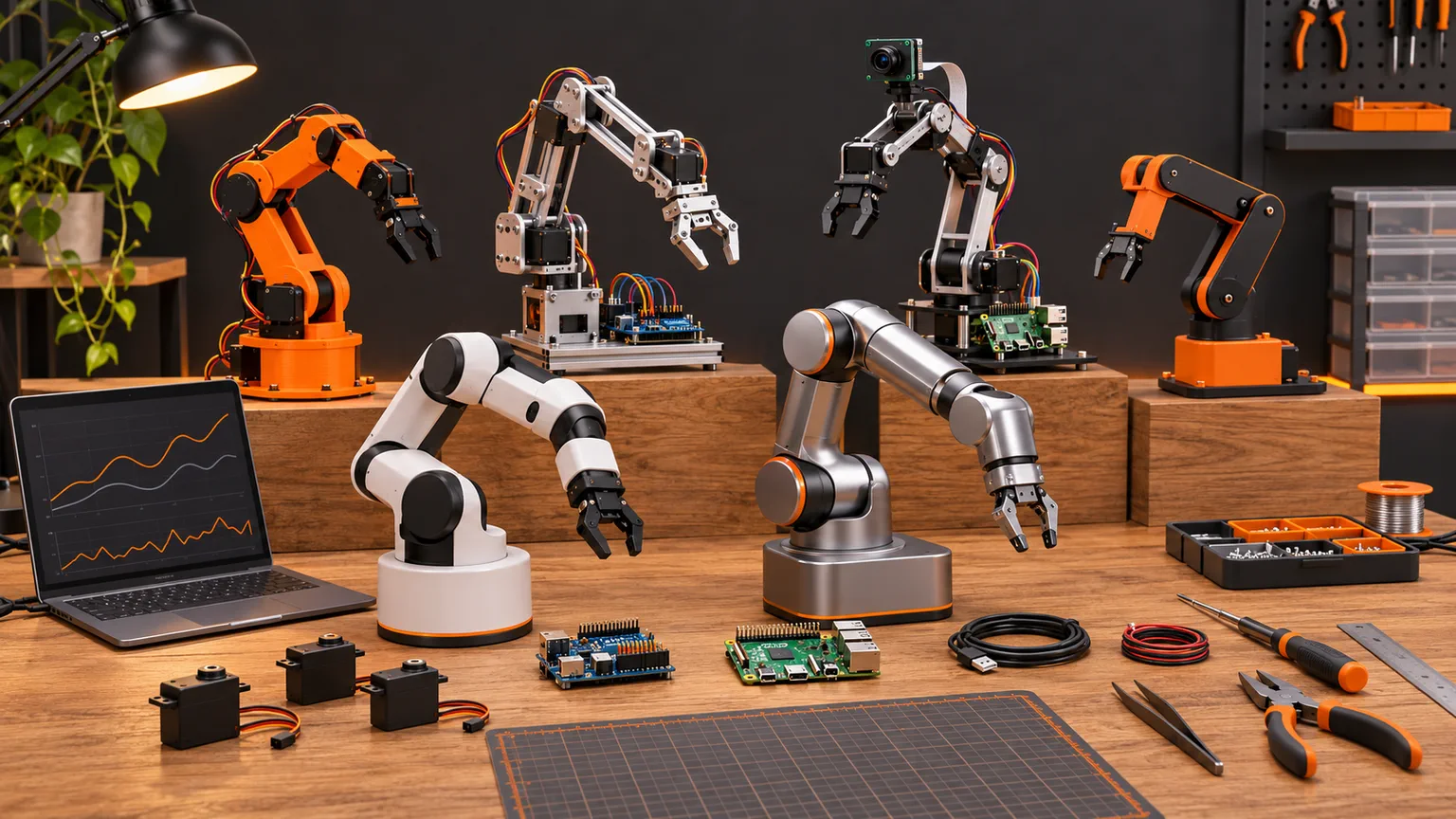
The best robot arm kit for most adults learning manipulation is the LeRobot SO-101. Its leader-follower design, Apache-2.0 hardware repository and LeRobot Python stack create a direct path from teleoperation to recorded demonstrations and trained manipulation policies. The official US parts example totals $121.94 for one follower arm or $229.88 for a leader-follower pair, before printing, delivery and tax.
Choose Hiwonder xArm AI when Arduino, Scratch and Python learning matter more than an open robot-learning stack. Choose Hiwonder ArmPi FPV for a Raspberry Pi vision arm with OpenCV and MoveIt. The Dobot Magician Lite is the structured four-axis classroom platform, Elephant myCobot 280 Pi is the six-axis ROS learning system and UFACTORY Lite 6 is the polished desktop cobot for serious lightweight automation.
This is a documentation-based buying comparison, not a controlled test. We checked the official US listings, specifications, software surfaces and prices on 10 November 2026; verify the exact variant before ordering because bundles change frequently.
Microduck is a biped, not an arm, so it is not ranked here. For locomotion and sim-to-real training rather than manipulation, use the Microduck vs SO-101 comparison.
What is the best robot arm kit for adults?
The best adult robot arm kit depends on the software layer you want to own. There is no honest universal winner across a $229 leader-follower learning kit and a $2,999 industrial-grade cobot. Choose the kit that leaves the least missing from your intended project: assembly, computer, camera, controller, software, safety hardware, documentation and spares.
How did we compare these robot arm kits?
We compared delivered contents, motion capability, controller and software support, expansion, documentation, starting cost and best-fit project. An extra axis did not automatically win because motion without a useful API or end effector does not improve the learning outcome.
The comparison uses official product pages and repositories as primary sources. We separated assembled products, construction kits and parts lists, and separated starter configurations from Raspberry Pi, camera, depth-sensor and AI bundles. No vendor paid for placement. Prices exclude taxes, delivery, spares and buyer time unless stated; quote-only products are labelled accordingly.
Which robot arm kit is best for your project?
Choose SO-101 for AI and imitation learning, xArm AI for Arduino and Scratch, ArmPi FPV for Raspberry Pi vision and MoveIt, Magician Lite for structured classroom work, myCobot 280 Pi for a six-axis ROS platform and Lite 6 for higher-payload desktop automation.
| Robot arm kit | Starting price signal | Main software path | Best for |
|---|---|---|---|
| LeRobot SO-101 | $121.94 follower; $229.88 pair | Python and LeRobot | Low-cost AI manipulation |
| Hiwonder xArm AI | From $269.99 | Arduino, Scratch and Python | Arduino and classroom programming |
| Hiwonder ArmPi FPV | From $299.99 | Python, OpenCV, ROS and MoveIt | Raspberry Pi vision |
| Dobot Magician Lite | Quote-based | MicroPython and DobotStudio | Structured classroom work |
| Elephant myCobot 280 Pi | $799 | Python, C++, ROS and MoveIt | Six-axis ROS learning |
| UFACTORY Lite 6 | From $2,999 | Python/C++ SDK, ROS and ROS 2 | Higher-payload desktop automation |
Is LeRobot SO-101 the best robot arm kit for AI?
Yes. SO-101 is the clearest low-cost route from physical teleoperation to a real manipulation dataset and a learned policy. Hugging Face's LeRobot software connects calibration, leader-follower recording, datasets, training and deployment in one Python ecosystem.
The follower arm carries the motors and gripper that execute the task, while the leader gives the operator a mechanically linked way to demonstrate joint motion. Recording a demonstration is a hardware and software workflow, not just moving a joystick inside an app.
What does the SO-101 kit include?
It depends on the seller. The official repository publishes the design, bill of materials and sourcing tables; vendors sell different combinations of printed parts, electronics and assembled hardware. The US parts example totals $121.94 for one follower and $229.88 for the pair, but still assumes parts that must be sourced or printed.
Confirm whether a listing includes the leader arm, printed frame, motors, control boards, power supplies, clamps and tools. A follower-only listing is not a complete teleoperation setup.
What can you program with SO-101?
The workflow is configure and calibrate each motor, map the joints, teleoperate the follower, record demonstrations and train a policy. Motor IDs, cable routing, limits and repeated demonstrations all affect dataset quality. SO-101 is excellent for embodied AI, but not a drop-in production cobot.
Who should choose SO-101?
Choose SO-101 when the project is manipulation learning and you are comfortable sourcing or printing parts. It offers the lowest credible starting price in this group and the strongest alignment with the open LeRobot stack. Read the SO-101 documentation and the SO-ARM100 hardware repository before choosing a seller.
Is Hiwonder xArm AI the best Arduino robot arm kit?
Yes, among the kits reviewed here. Hiwonder xArm AI combines a 5DOF arm plus gripper with an ESP32-based CoreX controller and three entry paths: Scratch, Arduino IDE projects and Python. The 293 × 153 × 426 mm aluminum arm weighs about 1.28 kg and uses intelligent bus servos.
Hiwonder provides inverse-kinematics material, PC and mobile control, sensor expansion and an optional AI module path for vision and voice experiments.
What are the kit options?
The official Hiwonder US listing checked on 10 November 2026 showed:
- Starter Kit: $269.99.
- Standard Kit: $339.99.
- Advanced Kit: $379.99.
The Advanced bundle adds the wider sensor set used in Hiwonder's vision, voice and multi-sensor examples. The lower-priced Starter kit is the sensible choice when you already own compatible cameras, sensors or controllers.
Why does xArm AI suit adult learners?
xArm AI exposes a useful progression: move joints graphically or with Scratch, then continue in Arduino and Python without replacing the robot. The 5DOF-plus-gripper design handles pick-and-place, angle control, inverse-kinematics exercises and sensor projects, but is not a six-axis industrial arm and does not offer LeRobot's dataset workflow.
Who should choose xArm AI?
Choose xArm AI for a classroom, a first Arduino robotics project or a structured adult-learning course where Scratch-to-Python progression matters. Choose SO-101 instead when imitation learning is the objective. Use the Hiwonder xArm AI product page to confirm the current bundle contents.
Is Hiwonder ArmPi FPV the best Raspberry Pi vision robot arm?
Yes, for buyers who want one integrated arm around Raspberry Pi, OpenCV and ROS MoveIt. ArmPi FPV pairs a 5DOF arm plus gripper with a 120° wide-angle camera, intelligent serial-bus servos and an aluminum frame.
The listed dimensions are 277 × 177 × 428 mm and the product weighs about 1.2 kg. Hiwonder rates the gripper for a maximum 1.5 kg when bent and more than 500 g when straightened. Those figures describe a favourable static or near-static lift, not a guarantee of payload at full speed and reach.
What software and lessons are included?
ArmPi FPV supports Python, OpenCV, ROS, MoveIt and mobile or PC control. Examples include color recognition, target tracking, sorting, palletizing and vision-guided grasping. The Raspberry Pi is the computer, so a kit without the board is incomplete until the buyer supplies a compatible Pi 4B or 5 and OS image.
What does ArmPi FPV cost?
The Hiwonder US listing started at $299.99 for the Standard kit without a Raspberry Pi. The same kit with a Pi 5 2GB was $429.99, and the Developer kit with an 8GB Pi 5 reached $689.99. A base price without the Pi, camera, power supply or advanced sensors is not directly comparable with an all-in kit.
Who should choose ArmPi FPV?
Choose ArmPi FPV when the project combines a Raspberry Pi Linux environment, computer vision and an arm that can be programmed through Python and ROS. Choose a lower-cost Arduino arm when Linux and MoveIt are unnecessary, or myCobot 280 Pi when a true six-axis ROS platform matters more than the integrated vision curriculum. See the ArmPi FPV product page for the current variants.
Is Dobot Magician Lite the best classroom robot arm?
Yes, when the buyer wants a polished four-axis teaching platform with vendor curriculum, accessories and a support path. Dobot's Magician Lite is designed for K12 education and combines a compact robot with the external Magic Box controller and expansion ecosystem.
The official specifications list 4 degrees of freedom, 250 g maximum payload, 340 mm maximum reach, ±0.2 mm repeatability and a 2.4 kg arm weight. The system supports soft grippers, suction cups and a pen holder. Dobot also documents collision detection and a MicroPython path through DobotStudio and DobotLab.
Why choose four axes?
Four axes cover pick-and-place, drawing, stacking and basic vision-guided handling while removing two coordinated joints from the teaching problem. The trade-off is motion freedom: Magician Lite cannot match the wrist orientation or reach of a six-axis arm.
Why is the price quote-based?
Dobot's reviewed page presents a sales-contact route instead of a public transaction price because education bundles can include software, curriculum, accessories, training and local support. Request a written quote for the exact arm, controller, gripper, sensor kits and support, then compare the delivered classroom package rather than the robot alone.
Who should choose Magician Lite?
Choose Magician Lite when a school or training lab wants a recognized education platform, collision detection, structured materials and an established local procurement path. Individual makers who want the cheapest inspectable arm should start with SO-101 or xArm AI. Review the Magician Lite specifications before requesting a quote.
Is Elephant myCobot 280 Pi the best six-axis ROS learning arm?
Yes, for adults who want an assembled six-axis arm and a computer integrated into the robot. The myCobot 280 Pi uses a Raspberry Pi 4B, can run independently without a connected PC and documents Python, C++, Blockly, ROS and MoveIt workflows.
The reviewed model has a 280 mm working radius, 250 g payload and six servo-driven axes. Its ecosystem includes more than 90 control interfaces, graphical control, move-and-teach examples, optional cameras and grippers, and an AI kit for object-recognition and grasping projects.
What does the Raspberry Pi version add?
The Pi version integrates an Ubuntu-based development environment into the robot. Connect a monitor, keyboard and mouse and it can run as a standalone Linux robotics platform. Elephant also sells M5Stack, Jetson Nano and Arduino variants, so confirm the exact compute and software path before following a tutorial.
What does myCobot 280 Pi cost?
The official Elephant Robotics shop listed the myCobot 280 Raspberry Pi 2023 arm at $799 on 10 November 2026. Grippers, cameras, suction pumps, AI kits and all-in-one suites change the delivered price substantially. The premium buys an integrated six-axis platform with onboard compute, vendor software, simulation examples and support.
Who should choose myCobot 280 Pi?
Choose myCobot 280 Pi when ROS, MoveIt, Linux, six-axis motion and an assembled robot are the requirements. It suits university labs, advanced makers and training environments that need a stable hardware platform more than a low-cost build project. Check the myCobot 280 Pi listing for the current bundle.
Is UFACTORY Lite 6 worth the premium?
Yes, when the robot must support repeated lightweight automation rather than classroom exploration. UFACTORY positions Lite 6 as a compact industrial-grade cobot with harmonic drives, a built-in control box, 600 g payload, 440 mm reach, 6DOF and ±0.5 mm repeatability.
The arm weighs about 8 kg and has a stated maximum TCP speed of 0.5 m/s. It provides open Python and C++ SDKs, ROS and ROS 2 packages, a graphical interface and simulation-ready workflows. The current UFACTORY page listed a starting price of US$2,999.
Why not use a hobby arm for automation?
An application that repeats for months needs repeatability, tooling, collision protection, production software, spares, service documentation and a safe integration boundary. Lite 6 targets those expectations, but remains a small collaborative robot rather than a complete automation cell. A deployment may add a gripper, camera, fixture, safety assessment, PLC integration and custom software, so the starting price is only the beginning of the budget.
Who should choose Lite 6?
Choose Lite 6 when the goal is a compact, repeatable desktop or light-duty commercial task and the buyer can support a professional integration. Choose myCobot 280 Pi for lower-cost ROS learning, SO-101 for AI dataset experiments, or Magician Lite for a classroom workflow. Review the UFACTORY Lite 6 specifications for the complete technical data.
How many degrees of freedom do you need?
Four axes cover basic pick-and-place, drawing and classroom demonstrations. Five axes plus a gripper add orientation for many vision-sorting projects, while six axes provide the full spatial orientation expected from a collaborative or research arm.
A 5DOF-plus-gripper arm is often marketed as six-function because the gripper opens and closes, but it is not a sixth rotational wrist axis. Four or five axes reduce the coordinate burden for beginners; ROS, autonomous manipulation and production prototyping benefit from six.
What payload and reach do you need?
Start with the complete end effector and object mass, then choose an arm rated well above that load at the actual speed and reach. Payload ratings are not interchangeable, and grip force is different from lifting capacity.
The reviewed arms span 250 g for Magician Lite and myCobot 280 Pi, 600 g for Lite 6, and approximately 500 g straight or 1.5 kg bent for the ArmPi FPV gripper. SO-101 and xArm AI are learning arms, not production load platforms. Check official drawings rather than assuming full payload at every angle.
Which software stack should you choose?
Choose Scratch and Arduino for electronics and introductory programming, Raspberry Pi and OpenCV for Linux vision, and ROS plus MoveIt for transforms, motion planning and system integration. SO-101 adds Python, teleoperation, datasets and LeRobot policies; Lite 6 adds professional SDK and ROS packages for automation.
The controller matters as much as the language. A product can claim Python while requiring a proprietary desktop helper, or claim Arduino while shipping fixed firmware. Verify that the API exposes joints, sensors, timing, errors and end-effector control.
What does a robot arm kit cost after extras?
Add the computer or Raspberry Pi, camera, depth sensor, gripper, power supply, mounting hardware, spare servos, software support, shipping, tax, assembly and calibration. SO-101's $229.88 parts example excludes printing and delivery; xArm AI ranges from $269.99 to $379.99; ArmPi FPV rises from $299.99 without a Pi; myCobot starts at $799; and Lite 6 starts at $2,999 before integration.
Classrooms add teacher time, storage, replacements and robots per student. Labs add safety assessment and software maintenance. Commercial tasks add fixtures, integration labour and downtime risk. The cheapest quote can produce the most expensive project when a critical component is missing.
Which robot arm kit fits your project?
Choose by the outcome you need to demonstrate, not by the longest feature list:
- AI imitation learning: LeRobot SO-101.
- Arduino, Scratch and introductory Python: Hiwonder xArm AI.
- Raspberry Pi camera and ROS MoveIt: Hiwonder ArmPi FPV.
- Structured four-axis classroom work: Dobot Magician Lite.
- Assembled six-axis ROS learning: Elephant myCobot 280 Pi.
- Repeatable lightweight automation: UFACTORY Lite 6.
- Locomotion and embodied AI instead of manipulation: Microduck versus SO-101.
If you need competition between several robot categories, use the best programmable robot kits for adults or the best robot kits for adults. If the project is reinforcement learning rather than buying hardware, start with the best robots for reinforcement learning.
Are robot arm kits safe for beginners?
Robot arm kits are not automatically safe because they are small. Pinch points, unexpected motion, a dropped object and a running motor can cause injury or damage at desktop scale.
Clamp the base, clear the work envelope, use conservative speed and current limits, and keep the emergency stop or power cutoff within reach. Test without a tool or object first. Children need appropriate supervision, and schools or workplaces must follow manufacturer instructions and complete a site-specific risk assessment.
Key takeaways
- SO-101 is the best value for AI, teleoperation and imitation learning, provided you can print or source the hardware.
- xArm AI is the clearest Scratch, Arduino and Python teaching progression.
- ArmPi FPV is the focused Raspberry Pi vision and ROS MoveIt kit.
- Magician Lite is a quote-based four-axis classroom platform; compare the complete education package.
- myCobot 280 Pi is the assembled six-axis ROS option at $799 before accessories.
- Lite 6 begins at $2,999 and targets real lightweight automation rather than learning alone.
Best robot arm kits for adults FAQ
What is the best robot arm kit for adults overall? SO-101 is the best low-cost choice for AI and imitation learning because its open hardware, leader-follower workflow and LeRobot software form a complete learning path. Budget $229.88 for the official parts pair before printing, delivery and tax.
What is the cheapest robot arm kit? The lowest official signal is SO-101 at $121.94 for one follower or $229.88 for the pair. It excludes printed parts where applicable, shipping, tax and tools.
Which robot arm kit is best for AI? SO-101 is the direct choice because LeRobot supports teleoperation, datasets and imitation learning. ArmPi FPV is the packaged vision route; myCobot and Lite 6 are stronger ROS platforms.
Which robot arm kit is best for Arduino? Hiwonder xArm AI is the clearest Arduino option, with Scratch and Python support and an ESP32-based CoreX controller.
Which robot arm kit is best for Raspberry Pi and ROS? ArmPi FPV is the best integrated Raspberry Pi vision arm; myCobot 280 Pi is the stronger assembled six-axis ROS platform.
How much weight can an adult robot arm kit lift? Ratings range from 250 g on Magician Lite and myCobot 280 Pi to 600 g on Lite 6. ArmPi FPV lists 1.5 kg when bent and more than 500 g when straightened. Keep a safety margin.
Do I need a 3D printer for a robot arm kit? SO-101 requires printed parts unless you buy a printed or assembled configuration. The other kits vary, so verify each variant.
Are robot arm kits safe for beginners? They are suitable for supervised learning when the base is secure, speed and force are limited and a power cutoff is available. Never treat a small arm as harmless.
Where to go next
- Best open-source robot arms - compare reproducible designs, licences and BOMs.
- Best programmable robot kits for adults - compare SDK depth and controller platforms.
- Best robots for reinforcement learning - build a complete training loop.
- Microduck vs SO-101 - choose locomotion or manipulation.
- Microduck alternatives - compare robots by task, budget and openness.
- Pre-order Microduck - see the $399 assembled biped if your goal is embodied AI rather than an arm.